Finding the right 1 liter glass beaker hinges on durability, accuracy, and ease of use. This guide highlights five strong options, suitable for professional labs, educational settings, and home science projects. Best for heavy use: sturdy borosilicate beakers with clear graduations. Best for classrooms: beakers with reliable spouts and easy-to-read scales. Best for budget-friendly kits: multi-pack options that maintain accuracy and heat resistance.
| Product | Brand | Volume | Key Benefit |
|---|---|---|---|
| United Scientific Borosilicate Glass Beaker | United Scientific | 1000 ml | Autoclavable; precise 50 ml graduations |
| Corning Pyrex 1000-1L Beaker | Corning | 1000 ml | Trusted Pyrex quality; clear dual-scale |
| Karter Scientific 213D19 | Karter Scientific | 1000 ml | Low form; printed graduations; durable |
| Aeseusia 1000 ml Beaker | Aeseusia | 1000 ml | Thick borosilicate; double scale; spill-resistant spout |
| Pyrex 1L Griffin Beaker (2-Pack) | Pyrex | 1000 ml | Low form; durable; clear metric markings |
United Scientific Beaker 1000 ml
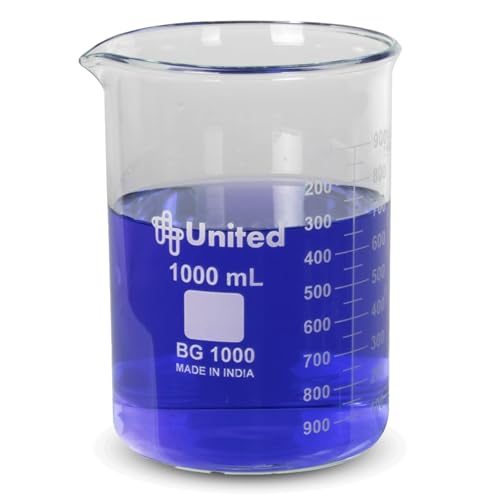
Best for frequent autoclaving and high-heat experiments. This borosilicate beaker features double-scale graduations from 100–900 ml in 50 ml increments, meeting ASTM-E960 standards with ±5% tolerance for accurate readings. The 3.3 borosilicate glass offers heat resistance and chemical compatibility, making it suitable for sterilization and repeated heating cycles. The wide-base design provides stability during mixing and heating, reducing spill risk. Consider this beaker if you need high precision and durability in a busy lab or teaching lab environment.
Who it’s best for: researchers and educators who require autoclavable beakers with reliable measurements and strong thermal tolerance. Caution: the tolerance is ±5%, so extreme precision tasks may require cross-checking with a secondary measurement tool.
Corning Pyrex 1000-1L Beaker

Better for classrooms and educational labs that prioritize recognizable brand reliability. The beaker has a 1000 ml capacity with 50 ml graduations and a low-form Griffin shape, which helps with stability during pouring and mixing. Pyrex glass is known for thermal shock resistance and durability in routine lab tasks. Choose this if you want a trusted, widely available beaker with straightforward metric markings.
Best for: school labs and teaching demos where predictable performance and easy replacement parts matter. Limitation: single-volume description in some listings may require verifying graduation accuracy for critical measurements.
Karter Scientific 213D19 Beaker

Best for large-capacity applications that require clear measurements and sturdy construction. This 1000 ml low-form beaker offers 50 ml graduations from 100 ml to 1000 ml, with a height of about 155 mm and an outside diameter of roughly 106 mm. The beaker is made from 3.3 borosilicate glass, providing good chemical resistance and mechanical strength. Ideal for labs performing bulk mixing or reaction work where visible measurements and stability matter.
Best for: researchers needing a robust beaker with big-volume readability. Limitation: some listings emphasize capacity and dimensions over advanced features like autoclavability; verify compatibility with your sterilization protocol.
Dlh Western 1 L Beaker
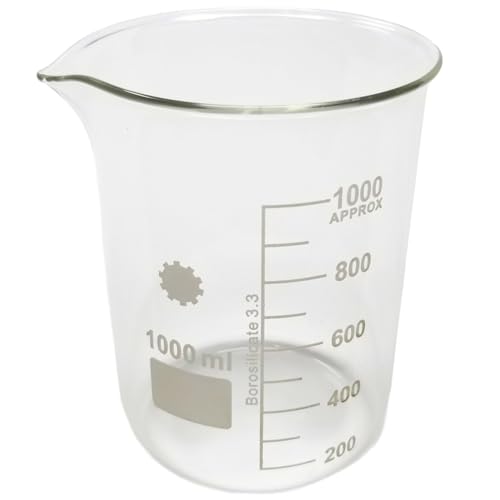
Best for general-purpose lab use with strong clarity and chemical resistance. This borosilicate 3.3 glass beaker features a graduated metric scale and a low-form Griffin profile for stable handling. It emphasizes strength, stability, and clarity, making it suitable for routine measurements and demonstrations in classrooms or labs. Consider this option if you want a straightforward, reliable beaker for daily tasks.
Best for: everyday lab work and teaching activities where low-form design reduces tipping risk. Caution: data highlights general performance; for critical volumetric work, cross-check with a secondary instrument.
Pyrex Griffin Beaker 1L (2-Pack)

Best for combined classroom kits and shared lab resources. This Pyrex Griffin beaker offers a low-form design with a spout and clear metric markings for easy measurement and pouring. The 1L capacity suits demonstrations and multi-sample experiments. The pack of two provides value for teaching labs or small research teams. Consider this option if you need multiple beakers with consistent markings.
Best for: education environments and light-duty research. Limitation: while durable, the listing highlights general features rather than advanced sterilization capabilities.
Buying Guide
What to look for when choosing a 1 liter glass beaker:
- Material: Most 1 L beakers are made from borosilicate glass (3.3) for heat resistance and chemical durability. This is preferred for autoclaving and repeated heating cycles.
- Graduations: Decide between single or double-scale graduations. Double-scale readings improve accuracy across varied tasks, but verify tolerances (typically ±5%).
- Form and spout: Low-form Griffin beakers offer stability and easy pouring. A V-shaped or well-designed spout reduces spills during transfer.
- Durability: Look for wide bases for stability and thick walls to resist thermal shock and breakage in busy labs or classrooms.
- Brand and compatibility: Reputable brands like Pyrex/Corning offer reliable performance and easier replacement parts, which is important in teaching environments.
Frequently Asked Questions
- What is the typical tolerance for 1 L glass beakers?
Answer: Many 1 L beakers have tolerances around ±5% for graduations, but it varies by brand and model. Verify the spec sheet when exact measurement is critical. - Are borosilicate beakers autoclavable?
Answer: Yes, most 3.3 borosilicate beakers are designed to withstand autoclaving and high-temperature cycles. - Which beaker is best for classroom use?
Answer: Beakers with a low-form Griffin shape, clear metric markings, and durable glass are ideal for classrooms and demonstrations. - Should I choose a beaker with a spout or without?
Answer: A beaker with a pouring spout reduces spills and enhances control during transfer; it is generally preferred for teaching and daily laboratory tasks. - Is a pack of beakers better than a single beaker?
Answer: Packs provide value for teaching labs and shared spaces, but ensure consistent quality across all units for uniform results. - What should I consider about beaker size and compatibility?
Answer: Ensure the beaker size fits your heating equipment, storage space, and the specific experiments you plan to conduct.