The best 3/4-inch water pressure regulator depends on where it will be installed and how much pressure adjustment you need. For household pressure monitoring, the FASBET includes a gauge and installation accessories; the Zixixvan offers an adjustable 25–75 psi range; and the Pinrui adds a built-in strainer. The Green living model is designed for tighter installation spaces, while the RVGUARD is made for RV plumbing and 3/4-inch garden hose connections.
| Product | Best For | Notable Feature |
|---|---|---|
| FASBET | Home users who want a gauge and accessories | Brass construction and included wrench |
| Zixixvan LF25AUB-Z3 | Adjustable household or commercial pressure | 25–75 psi adjustment range |
| Pinrui NR3XL | Installations where debris screening matters | Integrated stainless steel strainer |
| Green living | Compact or confined installations | 10–70 psi adjustment range and gauge |
| RVGUARD | Campers, trailers, and RV plumbing | 3/4-inch garden hose threads |
FASBET 3/4-Inch Regulator With Gauge

Best for: Homeowners looking for a 3/4-inch regulator kit with a visible pressure gauge and basic installation accessories. The listed package includes the pressure reducer, gauge, wrench, and sealing tape, so the key components are bundled together.
The DN20 valve is made from high-strength brass and is listed for pressures up to 1.6 MPa. Its gauge lets users monitor pressure instead of relying only on the adjustment setting. The manufacturer describes it for household, building, and factory applications and says it can be installed before many tap-water appliances.
Limitation: The provided product details do not state an adjustable outlet-pressure range. Check the listing or instructions for adjustment specifications before choosing it for a system that requires a particular setpoint.
Zixixvan LF25AUB-Z3 Adjustable Regulator

Best for: Buyers who need a defined adjustment range for residential, commercial, or industrial applications. This 3/4-inch valve is adjustable from 25 to 75 psi, with a listed 50 psi standard setting, and can withstand a maximum inlet pressure of 300 psi.
The product description also lists pressure balancing and automatic adjustment features. A thermal expansion bypass is described as allowing excess water to return to the main pipe. These specifications make this model a practical candidate when setpoint flexibility is more important than having a gauge included in the package.
Limitation: The supplied details do not mention an included gauge or strainer. Choose another option if either feature is essential to your installation.
Pinrui 3/4-Inch NR3XL Regulator

Best for: Homeowners and building managers who want a wide adjustment range and an integrated debris screen. The NR3XL is listed with a 15–75 psi range, a 50 psi factory default, and a maximum operating pressure of 400 psi.
Its cast bronze body is specified for residential, multi-unit, and commercial buildings. The built-in stainless steel strainer is intended to capture debris and help reduce clogging. That makes this model a better fit than a basic valve when filtering incoming particles at the regulator is a priority.
Limitation: The product details do not list a pressure gauge in the package. A separate gauge may be needed if you want to check downstream pressure directly.
Green Living Compact Adjustable Regulator

Best for: Installations with limited room around the water line. The listing describes a short, streamlined body and an FNPT dual-active interface that allows the valve body to be positioned without twisting fixed pipes. Its adjustment range is 10–70 psi, and it is described for hot- and cold-water systems.
This model includes a visual pressure gauge and an integrated stainless steel filter. The gauge supports pressure monitoring, while the filter is intended to catch debris. Choose it if compact dimensions and flexible positioning are important alongside pressure adjustment.
Limitation: The product information does not specify a maximum inlet pressure. Confirm that its pressure rating suits the intended supply before installation.
RVGUARD Lead-Free RV Pressure Regulator
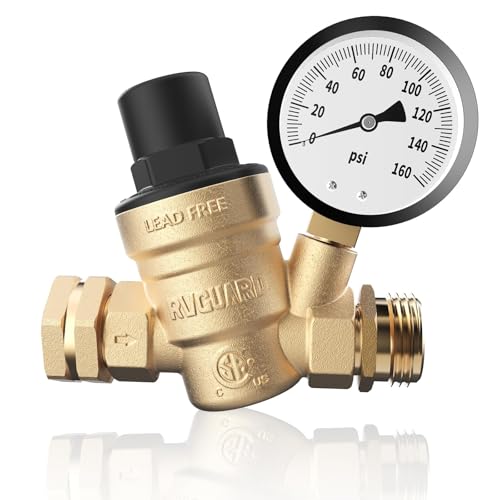
Best for: RV owners, campers, and trailer users who connect to a campground or other American water source. Unlike the household NPT-style options above, this regulator is specified with 3/4-inch garden hose threads. It also has an inlet screen to filter impurities.
The manufacturer states that the lead-free brass regulator is CSA approved and meets NSF/ANSI 61 and NSF/ANSI 372. These details make it the most purpose-specific choice in this group for RV fresh-water hose connections.
Limitation: Its garden hose thread connection is not the same as a 3/4-inch NPT pipe connection. Verify the thread type required by your plumbing before purchasing.
Buying Guide: How to Choose a 3/4-Inch Water Pressure Regulator
Is the connection NPT or garden hose thread?
“3/4 inch” does not identify one universal thread type. Household plumbing regulators commonly use pipe threads, while RV regulators may use garden hose threads. Match the regulator’s connection type to the supply line and fittings. The RVGUARD listing specifies garden hose threads; check other product listings and installation instructions for their exact connection details.
What pressure adjustment range do you need?
Compare the stated outlet-pressure ranges with the pressure required by your plumbing or appliances. Among these selections, the Green living model lists 10–70 psi, the Pinrui lists 15–75 psi, and the Zixixvan lists 25–75 psi. Do not assume that every regulator is adjustable; the FASBET details provided do not state a range.
Should you choose a gauge or a strainer?
A gauge helps you observe pressure at the regulator, while a strainer is designed to catch debris. The FASBET and Green living models list gauges; the Pinrui and Green living models list integrated strainers. Choose based on which feature matters most, and check whether the gauge measures pressure at the point you need to monitor.
What installation details should you verify?
Check flow direction, available space, connection type, maximum inlet pressure, and whether the valve is intended for the application. A compact body can help in a confined area, while a clearly marked flow arrow can make orientation easier. Follow the product instructions and local plumbing requirements; have a qualified plumber handle installation if needed.
Frequently Asked Questions
What does a water pressure regulator do?
It reduces or controls incoming water pressure to help maintain a lower downstream pressure. The appropriate setting depends on the plumbing system and the connected equipment.
Does every 3/4-inch regulator fit every 3/4-inch pipe?
No. The nominal size alone does not confirm thread compatibility. Check whether the valve uses NPT, garden hose thread, or another connection style.
What pressure should I set a household regulator to?
There is no single setting that suits every home. Check appliance and plumbing requirements, measure pressure with an appropriate gauge, and consult a plumber when you are unsure.
Is a built-in strainer necessary?
A strainer can capture debris before it reaches downstream components, but it may need inspection and cleaning. Whether it is necessary depends on water conditions and the rest of the system.
Can I use an RV regulator on household plumbing?
Do not assume it will fit. RV models may use garden hose threads and may have different intended pressure settings or use cases. Confirm connection type and specifications before installation.