Searching for a tangible DNA model? This guide highlights standout 3D DNA models ideal for students, educators, and science enthusiasts. Each pick helps visualize base pairing, the double helix, and molecular structure. The top choices are best for hands-on learning, classroom demonstrations, and desk decor that doubles as study aids. Below, compare features, best uses, and any limitations to help you choose.
Summary table of selected products
| Product | Best For | Key Benefit |
|---|---|---|
| VIUJUH DNA Double Helix Model | Students and teachers | Clear base-pair connectivity and 33 cm height |
| Vision Scientific VADNA1 DNA Model | Classroom demonstrations | Rotatable stand with removable phosphate |
| iplusmile DNA Model Kit | Middle/High school labs | Interactive joints and detachable parts |
| Veemoon DNA Model | Multi-angle study and home learning | Self-assembly, vivid base colors |
| hBARSCI DNA Model Kit | Science labs and larger demonstrations | Rotating 18-inch tall double helix |
VIUJUH DNA Double Helix Model

The VIUJUH model emphasizes base-pair concepts with interlocking pieces that form the double helix. It showcases how bases pair (A with T, G with C) and how strands separate at the center. The model stands about 33 cm (13 inches) tall, offering a practical scale for classroom demos and student exploration.
Best for: Educators needing a compact, visual aid to demonstrate base pairing and helix formation. Also suitable for students building foundational knowledge in genetics.
Why selected: Its clear base-pair connectivity and tall, accessible design help learners understand DNA structure without requiring complex assembly. A potential limitation: smaller size compared to some larger kits may reduce visibility in very large classrooms.
Vision Scientific VADNA1 DNA Model

This model features a durable PVC construction and a rotatable circular stand for dynamic visuals. The phosphate component can be removed and separated for closer inspection, which supports activities like illustrating replication or base-pair removal concepts.
Best for: Classrooms that value a steady, rotatable display and easy disassembly for laboratory-style demonstrations.
Why selected: The upright presentation and removable phosphate pieces support step-by-step explanations of DNA processes. Limitation: PVC may be less “premium” in appearance than crystal or resin models, but offers durability and cost effectiveness.
iplusmile DNA Model Kit

The iplusmile kit emphasizes hands-on assembly with flexible joints and detachable parts. Built to demonstrate the double helix, base pairing rules (A-T, C-G), and the spiral form, it supports interactive, student-led learning in middle and high school biology or genetics lessons.
Best for: Active classrooms and DIY learning where students manipulate components to reinforce concepts.
Why selected: Its interactive design fosters critical thinking and kinesthetic understanding. Caution: Assembly complexity may be challenging for younger learners without guided instruction.
Veemoon Double Helix DNA Model

Veemoon’s model offers a vivid, multi-angle representation of the DNA structure with a self-assembly design. It highlights the four DNA bases (A, T, C, G) and supports understanding of replication and information encoding through interactive construction.
Best for: Learners who benefit from assembling models themselves to see how strands coil and how bases align.
Why selected: Self-assembly encourages curiosity and reasoning about molecular arrangement. Limitation: Self-assembly may take longer than preassembled models, potentially slowing quick demonstrations.
DNA Double Helix Science Gift 3D Printed

This 3D-printed model provides a compact, five-inch-high representation crafted from PLA plastic. It serves as a portable gift or desk model for biology fans and students, offering a small-scale, durable option for demonstrating the double helix concept.
Best for: Individuals needing a small, decorative yet educational DNA model for desk use or gift purposes.
Why selected: Its size and material make it easy to display and share. Limitation: The smaller scale may limit visibility in larger groups or demonstrations requiring large displays.
DNA Double Helix Model

This educational kit focuses on ease of assembly and disassembly, making it suitable for quick demonstrations and student-led exploration of DNA structure. It emphasizes the fundamental double helix arrangement and its instructional value.
Best for: Beginners or classrooms needing a straightforward model for introductory genetics lessons.
Why selected: Simplicity and rapid setup support efficient teaching moments. Limitation: Fewer advanced features compared with larger or more complex models.
Movdyka 3D Crystal DNA Model
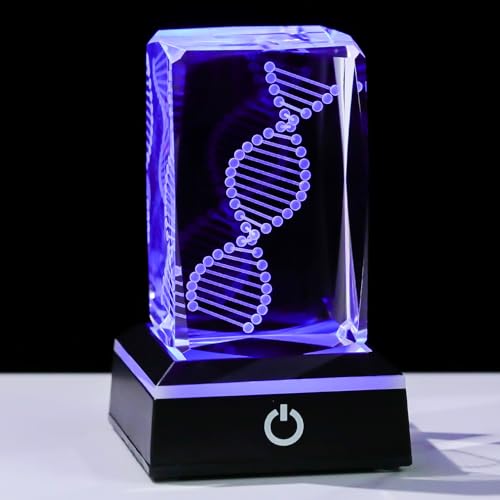
Movdyka’s crystal DNA model doubles as a decorative piece and a teaching tool. It uses laser-engraved crystal with an LED base that cycles colors, providing a visually striking representation of the double helix in a modern, space-saving form.
Best for: Science classrooms and offices wanting a standout visual aid that also glows for emphasis during lessons.
Why selected: Combines elegance with educational value; caution: crystal pieces require careful handling to avoid chips or damage.
Buying Guide: Key Considerations for DNA Models
- Scale and visibility: Choose a size that suits your space. Larger models are easier to view from a distance in classrooms.
- Material quality: PVC and PLA are common; crystal models look premium but require gentler handling.
- Interactivity: If students benefit from hands-on learning, prefer kits with detachable parts and joints.
- Base-pair clarity: Look for color coding or labeling of A, T, C, G bases to reinforce learning.
- Assembly effort: Some kits are preassembled, others are self-assembly; match to your lesson plan and time constraints.
- Durability: Consider durability for frequent classroom use or student handling.
- Display versatility: Rotating stands or modular designs support multiple teaching angles and demonstrations.
- Compactness vs. feature set: Balance the need for a striking display with classroom footprint and budget.
FAQ
- What are the advantages of a rotating DNA model?
It helps demonstrate the three-dimensional arrangement and facilitates viewing from different angles during lessons. - Which DNA model is best for beginners?
Look for simple, easily assembled models that clearly show base pairing and the double helix without overwhelming details. - Are crystal DNA models more durable than plastic ones?
Crystal models are visually striking and can be durable, but they require careful handling to avoid damage; plastic models are typically more forgiving in busy classrooms. - How should I choose between a self-assembly kit and a preassembled model?
Self-assembly promotes active learning and reasoning about structure, while preassembled models save instructional time for demonstrations. - Can DNA models aid in remote learning?
Yes; models can be shown in video or virtual labs to illustrate concepts like replication and base pairing clearly. - Do these models illustrate RNA differences?
Most DNA models focus on double-stranded DNA; some kits can be repurposed to discuss basic differences but may not depict RNA structure explicitly.