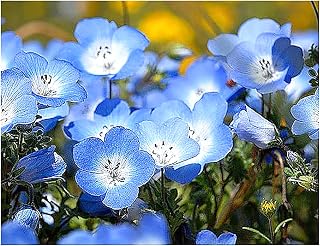
Baby blue eyes flowers are low-growing annuals known for blue blooms with pale centers, making them a good choice for spring borders, containers, and naturalistic plantings. Among the relevant seed listings, Sow Right Seeds is best for gardeners who want detailed sowing instructions, Marde Ross & Company offers a stated 3,000-seed count, and the 1,000-seed packet is positioned for mass planting. The listings provide different growing directions, so check each packet and match sowing time to your local climate.
| Product | Best suited for | Listed seed count |
|---|---|---|
| Sow Right Seeds Baby Blue Eyes | Gardeners who want specific spacing and timing guidance | About 300 |
| Wivolibe Baby Blue Eyes Seeds | Buyers seeking a larger stated seed quantity | 1,200+ |
| Marde Ross & Company Wildflower Seeds | Fall or early-spring sowing plans | 3,000 |
| Baby Blue Eyes Annual Nemophila Seeds | Large spring displays from direct sowing | 1,000+ |
Sow Right Seeds Baby Blue Eyes

This packet contains at least 500 mg of California-native Baby Blue Eyes seed, described as about 300 seeds. The listing says the plants grow 3–6 inches tall, spread 6–12 inches, and mature in 55–60 days. It recommends sowing 1/16 inch deep, spacing plants 6 inches apart, and choosing partial shade.
Best for: Gardeners who want a compact flower bed and clear planting measurements. The listing also notes that the flowers attract bees and butterflies. It gives a germination range of 7–30 days at soil temperatures of 65–75°F.
Keep in mind: The stated USDA zones are 7–10, so gardeners outside that range should check local growing conditions rather than assume the same results.
Wivolibe Baby Blue Eyes Wildflower Seeds

This listing states that the packet contains more than 1,200 seeds. It describes plants reaching about 4 inches tall, with blue flowers and a preference for full sun to partial shade. Its sowing instructions say to sow four to five seeds per plant and keep the soil moist until germination, which it estimates at 7–21 days.
Best for: Buyers who want a higher stated seed count and are planning a broad low-growing planting. The listing describes moist but well-drained soil as preferred.
Keep in mind: The product description includes wording about “water lilies,” which conflicts with its Baby Blue Eyes seed description. Verify the plant identity and packet details before purchase. It also says the plant does not tolerate humidity well.
Marde Ross & Company Wildflower Seeds
This packet is listed as containing 3,000 Baby Blue Eyes seeds. The product details give a mature height of 4–12 inches and say the plants do best in full sun while tolerating some shade. The listing recommends sowing in fall in mild climates or early spring in other regions.
Best for: Gardeners looking for a larger seed quantity and flexible seasonal sowing guidance. Its stated height range can help buyers compare it with shorter listings when planning a mixed planting.
Keep in mind: The product details do not provide a germination timeframe, sowing depth, or spacing. Use the packet instructions for those specifics instead of applying another brand’s directions automatically.
Baby Blue Eyes Annual Nemophila Seeds

This listing offers more than 1,000 seeds and describes the flowers as annuals with blue petals and white centers. It presents Baby Blue Eyes as a cool-weather flower for early spring color, with fall planting suggested in mild-winter regions. Its instructions recommend scattering seed over prepared soil and lightly raking it in.
Best for: Buyers planning a larger direct-sown display who prefer simple broadcast-style planting instructions. The listing emphasizes cool conditions and minimal maintenance.
Keep in mind: It does not specify planting depth, spacing, germination time, or mature height. Those details may matter for precise bed layouts, so check the seed packet for additional directions.
Buying Guide: Choosing Baby Blue Eyes Seeds
How many seeds do you need?
Compare the stated quantity with the area you plan to sow. The listings range from about 300 seeds to 3,000 seeds. A larger count may suit broad coverage, while a smaller packet can be more practical for a limited bed. Seed count alone does not determine coverage: spacing, germination, and planting method also affect how many plants establish.
When should you sow them?
Product directions differ. One listing recommends fall sowing in mild climates and early spring elsewhere, while another describes the flowers as cool-season annuals and suggests early spring or fall in mild-winter regions. Follow the instructions for the specific packet and consider your local seasonal conditions.
What light and soil conditions should you plan for?
The supplied product details range from partial shade to full sun, with some listings allowing either. Wivolibe describes moist but well-drained soil and cautions against humidity. For a particular packet, prioritize its own directions; avoid assuming that every listing has identical growing requirements.
How should you compare planting instructions?
Look for sowing depth, spacing, germination timing, and mature plant size. Sow Right Seeds provides details for all four, while some other listings give only a subset. Direct sowing can be straightforward, but exact steps vary by product. Do not transfer one brand’s measurements to another packet unless its instructions support that approach.
Frequently Asked Questions
Are Baby Blue Eyes flowers annuals?
One supplied listing identifies Baby Blue Eyes as an annual. Check the selected packet for its own plant description and growing guidance.
How tall do Baby Blue Eyes grow?
The listings give different heights: about 4 inches, 3–6 inches, and 4–12 inches. Use the height stated for the seed product you choose when planning a garden bed.
Do Baby Blue Eyes seeds need full sun?
Recommendations vary. Some listings favor full sun, while another recommends partial shade and others allow a range from full sun to partial shade. Follow the directions on your packet and account for your garden’s conditions.
How long do Baby Blue Eyes seeds take to germinate?
Listed estimates vary from 7–21 days to 7–30 days. Not every product provides a germination estimate, so check its packaging for product-specific information.
Are artificial baby’s breath flowers the same as Baby Blue Eyes?
No. Baby’s breath is a different flower, and artificial baby’s breath is not a Baby Blue Eyes seed product. The artificial-flower listing is not included in this seed comparison.