Whether you’re a professional HVAC technician or a DIY homeowner, bubble-based leak detectors offer fast, visual confirmation of leaks in gas lines, refrigerant systems, and air plumbing. This guide highlights five reliable bubble leak test solutions best suited for identifying micro-leaks under varying conditions. The selections favor clear, high-visibility bubbles, multi-gas compatibility, and ease of application. Use this overview to compare options and choose the right product for your specific system and environment.
| Product | Best For | Volume | Notes |
|---|---|---|---|
| RectorSeal Better Bubble 65554 | Small to medium HVAC piping and coils | 8 oz | Fast-acting, versatile temperatures |
| ComStar Leak Bubbles Blue (1 qt) | HVACR systems and gas lines requiring visible blue bubbles | 1 qt | All-weather, non-freezing |
| ComStar Leak Bubbles Yellow (1 qt) | Propane, gas lines, and refrigeration lines needing bright yellow cues | 1 qt | All-weather, non-freezing |
| RectorSeal Better Bubble 65432 | General plumbing leaks and refrigerant systems | 32 oz | Fast acting, broad compatibility |
| Gasoila Extreme Temperature Leak Detector | Gas & air systems with extreme temperatures | 1 gallon | Long-lasting bubbles, non-toxic |
RectorSeal Better Bubble 65554 Advanced Leak Detector

Features: Detects refrigerant gas, air, oxygen, and most gas leaks. Works across surface temperatures from 20°F to 250°F. Easy to spray or apply on pipes, tubing, tanks, pressure vessels, condensers, evaporator coils, and refrigerant coils. Best for small to medium HVACHR components where quick localization is required.
Best for: Technicians or homeowners testing smaller plumbing sections, refrigerant lines, and coil assemblies. This formulation supports varied temperature and pressure conditions, making it flexible for seasonal or climate differences. Choose this if you need a fast, reliable pinpoint of leaks in common HVACR applications.
Caution: Avoid spraying on bare electrical components or energized systems. Test a small area first to confirm compatibility with surface materials.
ComStar Leak Bubbles Blue 1 qt
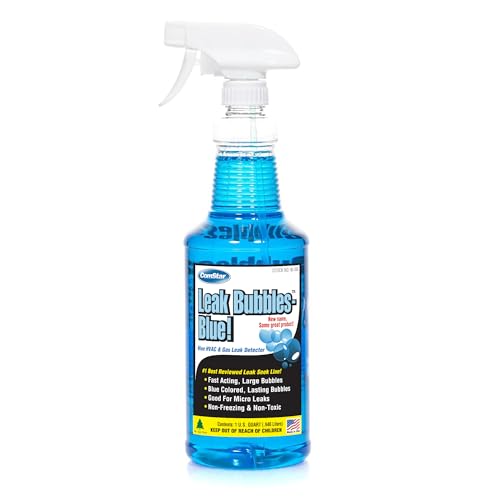
Features: Instant visual leak detection with high-visibility blue bubbles at the leak source. All-weather and non-freezing formula suitable for outdoor propane tanks, indoor AC units, and various gas lines. Multi-gas compatibility covers natural gas, propane, nitrogen, air, CO2, and refrigeration gases.
Best for: Professionals performing year-round leak tests in outdoor or harsh environments, and homeowners inspecting BBQ grills or RV gas lines. It’s ideal when quick visual confirmation is needed across multiple gas types.
Caution: Not all formulations are optimal for oxygen systems; avoid using on pure oxygen lines to prevent unintended reactions or misinterpretation of results.
ComStar Leak Bubbles Yellow 1 qt

Features: Instant visual leak detection with bright yellow bubbles for easy spotting. Performs well in all weather and remains non-freezing. Detects leaks across natural gas, propane, nitrogen, air, CO2, and refrigeration gases.
Best for: Situations requiring high-contrast indicators in low-light areas or where yellow bubbles are easier to track visually. Choose this if you want distinct visibility against dark backgrounds.
Caution: Similar to blue formulations, confirm compatibility with your target gas and avoid use on oxygen-specific systems where not advised.
ComStar Leak Bubbles Blue 1 gal

Features: High-visibility blue bubbles for instant leak pinpointing. All-weather, non-freezing formulation with multi-gas compatibility including natural gas, propane, nitrogen, air, CO2, and refrigeration gases. Suitable for large-volume testing in HVACR and gas piping.
Best for: Large systems or projects requiring extended bubble visibility, such as long pipe runs or expansive refrigeration circuits. Choose this if you need more product per application and broader coverage.
Caution: Ensure surfaces are dry before application to avoid bubble dilution or inconsistent results in humid environments.
Gasoila Extreme Temperature Leak Detector Spray

Features: Long-lasting bubbles with fast-acting pinpoint accuracy for micro leaks in gas lines, air systems, refrigeration condensers, and gas cylinders. Safe, non-toxic, non-corrosive, and compatible with all pipe types and materials.
Best for: Systems operating under extreme temperatures or requiring robust, high-visibility testing across different pipe materials. Applicable for automotive or industrial settings where standard formulations may underperform.
Caution: Not suitable for oxygen systems. Use as directed to avoid misinterpretation in high-oxygen environments.
Buying Guide: Key Considerations For Bubble Leak Test Solutions
- What gas types will you test? If you work with natural gas, propane, nitrogen, or refrigerants, choose a multi-gas compatible formula to cover all possibilities in one spray.
- Where will you test? For outdoor testing or cold climates, ensure the formula remains liquid and not freezing. For indoor use, consider a non-staining, easy-to-clean option.
- What is the system size? Smaller projects may benefit from 8 oz or 1 qt bottles, while larger installations may require 32 oz or 1 gal jugs to reduce reapplication frequency.
- Visibility preferences? Color-coded bubbles (blue vs. yellow) help with visibility in different lighting conditions or against specific backgrounds.
- Surface compatibility? Ensure the product adheres well to pipes, coils, tanks, and condensers without leaving residue that could affect measurements or operation.
- Safety and handling? Look for non-toxic, non-corrosive formulas and follow all manufacturer safety instructions to minimize exposure and contact with skin or eyes.
FAQ
- Q: Are bubble leak tests safe for all surfaces? A: Most are designed for common HVACR and plumbing materials, but always test a small area first and avoid sensitive electronics or energized components.
- Q: Can these be used in cold environments? A: Yes, many are formulated to stay liquid and effective in cold temperatures, including non-freezing formulas.
- Q: Do these work for oxygen systems? A: Some formulations are not suitable for oxygen systems; verify compatibility before use.
- Q: Which size should I choose? A: For occasional home use, 8 oz to 1 qt often suffices; for professional or larger systems, 32 oz or 1 gal offers better value and coverage.
- Q: Is a colored bubble better? A: Colored bubbles improve visibility in various lighting and surface backgrounds; select color based on your working environment.
- Q: Do these require special safety gear? A: Standard eye protection is advised; follow product-specific safety data for skin contact and ventilation requirements.