For carpenter bee pest control, choose a product that matches the treatment area: Spectracide’s foaming aerosol is best for active tunnels, while TERRO’s two-way spray suits broad or crack-and-crevice application. Atticus Tirade dust is an option for hard-to-reach areas where its label permits use. The products below include single-can, multipack, spray, and dust formats; always follow the product label for application and safety directions.
| Product | Best For | Format |
|---|---|---|
| Spectracide Carpenter Bee & Yellowjacket Killer | Treating active tunnels | Foaming aerosol |
| Spectracide Terminate | Indoor and outdoor listed-pest treatment | Liquid with AccuShot sprayer |
| Spectracide Three-Pack | Keeping multiple cans available | Foaming aerosol multipack |
| Atticus Tirade 1% Dust | Dry treatment in suitable hard-to-reach areas | Ready-to-use dust |
| TERRO Carpenter Insect Killer | Broad or precision spray application | Aerosol two-pack |
Spectracide Foaming Carpenter Bee Killer

This 16-ounce foaming aerosol is best for homeowners treating identified, active carpenter bee tunnels. Its foam expands into the area where insects live, and an extension tube is included for reaching difficult spots. The listed product features say bees distribute the insecticide throughout the nest after tunnel treatment.
Choose this if the target is a specific tunnel and you want a directed application rather than a general surface spray. It is also labeled for ground-nesting yellowjackets, but that additional use does not replace careful pest identification. A limitation is its targeted format: it is not described as a broad home barrier treatment. Follow the label’s directions for where and how to apply it.
Spectracide Terminate With AccuShot Sprayer

This 1.33-gallon product is best for buyers seeking an indoor and outdoor treatment for multiple listed pests, including carpenter bees. Its AccuShot sprayer is designed for application, and the product description says it kills listed insects on contact. It also states that it provides up to nine months of indoor control against carpenter ants.
Choose this if you need a larger-format treatment for more than one listed pest, rather than a small aerosol aimed at a single tunnel. The stated nine-month duration applies to indoor carpenter ant control; it should not be assumed to describe carpenter bee control. Check the label to confirm that the specific surface and application area are permitted.
Spectracide Carpenter Bee Killer Three-Pack
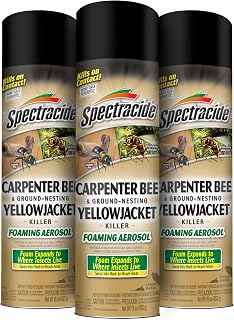
This three-pack is best for buyers who want multiple cans of the same targeted foaming treatment available. Its features match the single-can version: expanding foam, an extension tube for hard-to-reach areas, and use for treating active carpenter bee tunnels. The product is also described for ground-nesting yellowjackets.
Choose the multipack if you expect to treat more than one identified site or prefer to keep additional cans on hand. It offers the same application style as the single can, not a different treatment method. Avoid choosing it solely because it includes several cans if one targeted application is all you need; follow each can’s label directions and storage instructions.
Atticus Tirade 1% Dust Insecticide

Atticus Tirade is best for buyers who need a ready-to-use dust formulation for a hard-to-reach location where the label allows application. The product description identifies cyfluthrin as its active ingredient and lists control of flying, crawling, and wood-infesting insect pests. It does not require measuring or mixing, according to the listed features.
Choose this over an aerosol when a dust format better suits the treatment site and label directions. The product description lists many household pests, but buyers should check its complete control list and directions to confirm the intended carpenter bee use. A limitation is that application requires care to keep dust where it is directed; use the label as the authority for placement and precautions.
TERRO Carpenter Insect Killer Aerosol

This two-pack is best for buyers who want an aerosol with both broad application and precision spray options. Its two-way nozzle can be used for broad application or for cracks and crevices. The listed targets include carpenter bees, carpenter ants, and termites. The product description says it kills on contact and provides residual control for up to one month.
Choose TERRO if nozzle flexibility matters and you want a product described for indoor and outdoor use. Its stated residual period is up to one month, rather than the longer indoor carpenter-ant period listed for Spectracide Terminate. Use only in locations permitted by the product label.
Buying Guide: How To Choose Carpenter Bee Pest Control
Are you treating a tunnel or a broader area?
For an identified active tunnel, a foaming aerosol is the most directly targeted format among these options. The Spectracide single can and three-pack both describe foam treatment for active carpenter bee tunnels. For broader listed-pest treatment, compare the TERRO aerosol and Spectracide Terminate, checking the label for the exact site and pest.
Would spray or dust suit the application?
Aerosols are useful when the product’s nozzle or extension tube helps direct treatment. Dust may suit certain hard-to-reach areas, but only where its label permits it. Do not assume that every product can be applied to every wood surface, opening, or indoor location.
What does residual control mean here?
TERRO lists residual control for up to one month. Spectracide Terminate lists up to nine months of indoor control against carpenter ants, not carpenter bees. Compare claims only for the pest and setting specified by each product description, and consult the label before use.
Frequently Asked Questions
Which product is best for an active carpenter bee tunnel?
The Spectracide foaming aerosol is specifically described for treating active carpenter bee tunnels. Its extension tube helps direct foam into hard-to-reach areas.
Can these products also target other pests?
Yes. Listed additional pests vary by product and include carpenter ants, termites, yellowjackets, wasps, and other insects. Confirm the target pest on the specific product label.
Does the nine-month claim apply to carpenter bees?
No such duration is stated for carpenter bees. Spectracide Terminate’s listed claim is up to nine months of indoor control against carpenter ants.
Should I use foam, spray, or dust?
Choose based on the target location and label directions. Foam is described for active tunnels, spray offers nozzle-directed or broader application, and dust is a ready-to-use alternative for label-approved sites.