The best clip-on guitar tuner depends on how you play: the Fender FCT-2 suits musicians who switch instruments, the D’Addario Eclipse offers a readable adjustable screen, and the Snark SN5X covers several common stringed instruments. For a discreet setup, consider the D’Addario Micro; for rechargeable operation, consider the Nexxus 360. All five use a headstock clip, so they can sense instrument vibrations rather than relying only on room sound.
| Tuner | Best For | Standout Feature |
|---|---|---|
| Fender FCT-2 | Players with multiple instruments | Dedicated instrument modes and color LCD |
| D’Addario Eclipse | Players who want an adjustable display | Dual swivels and 435–450 Hz calibration |
| Snark SN5X | Guitar, bass, and violin players | Stay-put clip and 360-degree display |
| D’Addario Micro | Players who prefer a discreet tuner | Compact design and tri-color screen |
| D’Addario Nexxus 360 | Players who prefer rechargeable gear | USB charging and 360-degree rotation |
Fender FCT-2 Professional Multi-Instrument Tuner

The Fender FCT-2 is best for musicians who play guitar, bass, ukulele, or violin and want one tuner with dedicated modes for each. It also includes chromatic tuning, giving it flexibility for different tuning needs. Its vibration-sensing design is intended to work in loud venues as well as quiet practice rooms.
The color LCD needle display provides a clear visual indication of pitch and responds quickly. Choose this model if switching between instruments and easy-to-read feedback matter more than a minimal feature set. The listed features do not specify a calibration range, so players who need a particular reference pitch should check that detail before choosing.
D’Addario Eclipse Headstock Clip-On Tuner
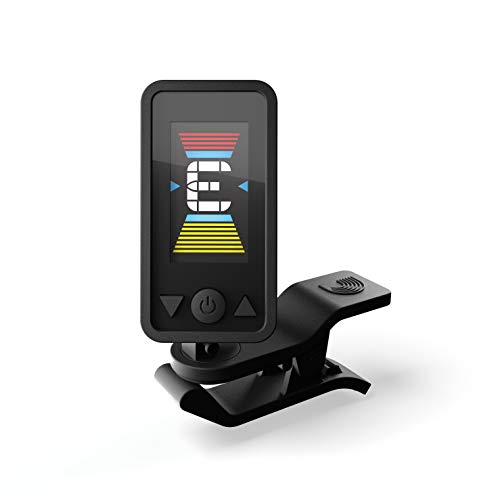
The Eclipse is best for guitar and bass players who want a large, adjustable screen. Its vertical full-color display has dual swivels for different viewing angles, including when mounted for left- or right-handed players. The adjustable clamp is designed to fit a variety of viewing positions.
Its stated calibration range is 435–450 Hz, which can be useful when players need to adjust the reference pitch within that range. Choose it if display positioning is a priority. It is listed for guitar and bass, so players looking for dedicated modes for several other instruments may prefer the Fender FCT-2.
Snark SN5X Clip-On Tuner

The Snark SN5X is best for players who want a straightforward clip-on tuner for acoustic or electric guitar, bass, or violin. Its “Stay Put” clip is designed to remain in position, and the display rotates 360 degrees to accommodate different viewing angles and left- or right-handed players.
This is a practical choice when those instrument options and a rotating display cover your needs. The supplied product details do not state its calibration range or describe separate instrument modes. If you need those specifications for a particular tuning setup, choose a model that lists them clearly.
D’Addario Micro Headstock Tuner
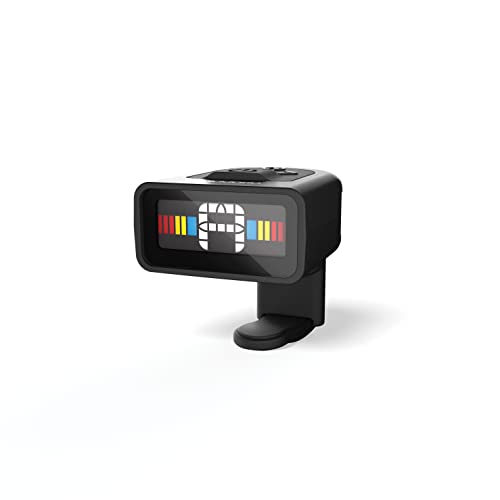
The D’Addario Micro is best for players who want a compact, discreet tuner that can stay on an instrument. Its 1.25-inch design clips behind the headstock, and its piezo transducer detects vibration. It is listed for acoustic and electric guitar, bass, mandolin, banjo, and ukulele.
The tri-color backlit screen shows red when a note is out of tune, yellow when it is close, and green when it is in tune. It uses an included CR2032 battery and has an auto-off function. Choose it if a small profile matters; avoid it if you prefer a larger display that is easier to see at a glance.
D’Addario Nexxus 360 Rechargeable Tuner
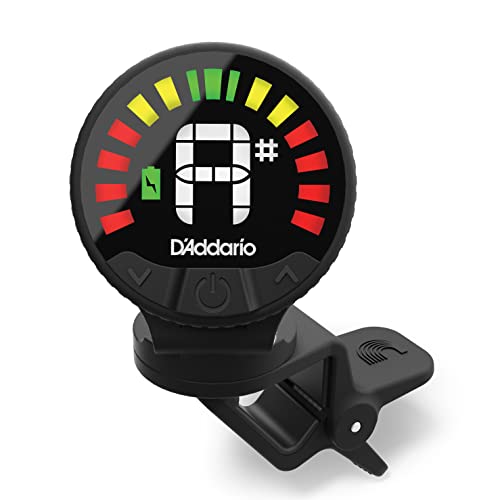
The Nexxus 360 is best for guitar or bass players who would rather recharge than replace tuner batteries. It provides up to 24 hours of tuning time per charge and recharges through a supplied USB cable connected to a USB power device. Its clamp rotates 360 degrees for flexible screen positioning.
The listed calibration range is 415–465 Hz, and calibration is adjustable. Choose this model if rechargeable operation and a broad stated calibration range are priorities. It requires charging, so it may be less suitable for players who prefer a tuner that runs on a replaceable battery.
Buying Guide: How to Choose a Clip-On Guitar Tuner
Do you need a tuner for more than guitar?
Check the listed instrument support before buying. The Fender FCT-2 offers dedicated modes for guitar, bass, ukulele, and violin, plus chromatic tuning. The D’Addario Micro is listed for guitar, bass, mandolin, banjo, and ukulele. For a single guitar or bass setup, the Eclipse or Nexxus 360 may provide a more focused fit.
Which display is easiest to position?
A rotating or swiveling screen can help you read the tuner from different angles. The Eclipse has dual swivels, while the Snark SN5X and Nexxus 360 list 360-degree rotation. The Fender FCT-2 emphasizes its color LCD needle display. Consider where you usually stand or sit when tuning.
Should you choose rechargeable or battery-powered?
The Nexxus 360 is rechargeable and lists up to 24 hours of tuning time per charge. The D’Addario Micro uses a CR2032 battery and includes an auto-off function. Choose based on whether you prefer USB charging or a replaceable battery; check each product’s included accessories and power details when ordering.
Does calibration range matter?
Calibration lets a tuner use a reference pitch other than the default setting. The Eclipse lists 435–450 Hz, the Nexxus 360 lists 415–465 Hz, and the Micro lists 410–480 Hz. If you tune to a specific reference, compare the stated range with your needs. The product details for the FCT-2 and SN5X do not specify a range.
Frequently Asked Questions
How does a clip-on guitar tuner work?
A clip-on tuner attaches to the instrument and detects vibrations through its contact with the headstock. This lets it identify pitch without depending only on sound picked up from the surrounding room.
Can a clip-on tuner work in a noisy room?
Vibration-sensing designs can be useful in noisy environments because they read instrument vibration rather than relying solely on audible sound. The Fender FCT-2 and Feluog product details specifically describe vibration sensing for loud settings.
Can one clip-on tuner tune a bass and a guitar?
Yes, if the tuner lists both instruments or offers a suitable chromatic mode. The Fender FCT-2, D’Addario Eclipse, Snark SN5X, and Nexxus 360 list guitar and bass support.
Where should a clip-on tuner be attached?
Attach it to the headstock as directed by the product design, then position the display so it is easy to read. A rotating or swiveling screen can make adjustment easier for different playing positions.