Miniature E10 screw-base bulbs are a staple for toy projects, educational experiments, and small lighting fixtures. This guide covers five reliable options, highlighting voltage, current, and common uses. Each product is shown with a quick overview to help you compare at a glance and choose bulbs that fit your circuit or device. All selections come from reputable sellers and are compatible with standard E10 sockets.
| Product | Base | Voltage / Current | Common Use |
|---|---|---|---|
| Sci-Supply Pack of 10 E10 Miniature Light Bulbs | E10 | 6.3V / 0.5A | General purpose miniature lamps |
| 10x E10 Miniature Light Bulbs (1.5V-12V) | E10 | 6V / 0.3A | Educational experiments, classrooms |
| Pack of 10 E10 3.8V / 0.2A Bulbs | E10 | 3.8V / 0.2A | Low-voltage indicators, small devices |
| Sci-Supply Pack of 10 E10 1.5V / 0.3A Bulbs | E10 | 1.5V / 0.3A | Low-voltage experiments, basic circuits |
| GutReise E10 12V / 0.3A Bulbs | E10 | 12V / 0.3A | Instrumentation, indicators |
Sci-Supply: 6.3V Miniature Bulbs (Pack of 10)

Sci-Supply provides a set of ten incandescent E10 miniature bulbs designed for low to moderate voltage applications. Each bulb operates at 6.3V and 0.5A, making them suitable for hobby projects, model lighting, and educational demonstrations. The bulbs are packaged by a U.S.-based small business known for customer care and reliability. They are ideal for experiments where a consistent brightness is needed without complicated power supplies.
Generic: 10x E10 6V 0.3A Bulbs for Experiments

These 10 E10 bulbs are designed for educational use, presenting a practical option for classrooms or home labs. With a base of E10 and a current rating of 0.3A at 6V, they are well-suited for simple circuit experiments, indicators, and small lighting tasks. They are commonly used where a straightforward, reliable light source is required for demonstrations and student projects.
Sci-Supply: 3.8V / 0.2A E10 Bulbs (Pack of 10)

This pack includes ten E10 bulbs rated at 3.8V and 0.2A, making them suitable for low-voltage devices and compact lighting fixtures. Their smaller voltage and current draw can help extend battery life in portable experiments or educational kits, while still delivering reliable incandescent light for demonstrations and model displays.
Sci-Supply: 1.5V / 0.3A E10 Bulbs

This 10-count set delivers 1.5V at 0.3A for each E10 bulb, making it a practical choice for small hobby projects and beginner electronics education. The compact form and easy replacement make these bulbs a staple for classroom labs and home science kits that explore basic circuits and lighting principles.
GutReise: 12V / 0.3A E10 Bulbs
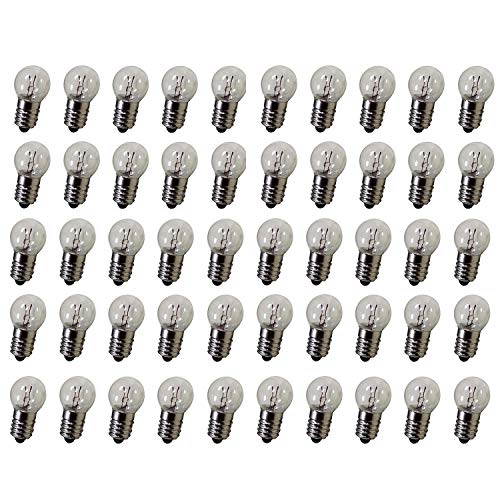
GutReise offers 12V, 0.3A E10 miniature bulbs suitable for instrumentation and precision lighting tasks. These bulbs are commonly used in equipment inspection lamps, microscopes, and small indicator lights within professional or hobbyist kits. Users should ensure their power source matches the 12V requirement to avoid overdriving the filament.
Honoson: 20-Piece E10 Bulbs (1.5V / 0.3A)

Honoson provides a bulk 20-pack of E10 bulbs rated at 1.5V / 0.3A, ideal for classrooms, science fairs, and multi-project setups. The assortment supports multiple experiments and model-making needs with easy replacement and storage. The compact size makes them convenient for travel or portable lab kits.
MeetUs: 12V / 0.5A E10 Bulbs

MeetUs offers a 10-count pack of E10 bulbs with 12V and 0.5A ratings, tuned for higher brightness in instrumentation and educational displays. The warm-white light and consistent performance make them suitable for hands-on projects and demonstrations that require steady illumination.
SQXBK: 0.2W 6V E10 LED Bulbs

These are LED-based E10 bulbs, offering 0.2W at 6V with a miniature base. LED variants can be appealing for experiments where energy efficiency or longer life is preferred. They replace incandescent bulbs in indicator lights, small displays, and educational kits that simulate electrical circuits without high heat output.
Buying Guide: Key Purchase Considerations
- Voltage compatibility: E10 bulbs come in various voltages (1.5V to 12V). Match the bulb voltage to your device or power supply to avoid overdriving filaments or dim lighting.
- Current draw and brightness: A bulb’s current rating (A) influences brightness and power use. For battery-powered projects, lower current can extend run time; for brightly lit demonstrations, higher current may be desired.
- Incandescent vs. LED: Incandescent E10 bulbs are common and inexpensive but consume more power and generate more heat. LED variants provide energy efficiency and longer life, though brightness and color temperature differ.
- Base compatibility: Ensure the E10 base matches your socket or fixture. Some educational kits include E10 sockets, while others require adapters.
- Size and packaging: For classroom kits or model projects, consider bulk packs (like 10 or 20 bulbs) to minimize replacement interruptions during demonstrations.
- Safety and age-appropriate use: Keep bulbs away from young children who might swallow small parts. Read product notes on size, heat, and handling.
- Application context: For experiments, align voltage and current with your circuit design. For indicators, consider whether constant or flicker-free light is needed.
- Quality and origin: Opt for bulbs from reputable brands or U.S.-based sellers when reliability and support are valued, especially for educational settings.