Answering the need for quick, reliable emergency exit access, this guide highlights five top emergency door release break glass options. The selections are best for facilities like schools, offices, shops, and public venues where fast evacuation is crucial. Each product is evaluated for ease of use, fire safety compliance, and installation practicality, helping you choose the right fit for your space and safety plan.
The table below summarizes the five recommended products, focusing on who they’re best for and why they stand out.
- UHPPOTE Resettable Fire Emergency Door Release Hand Glass Break Exit Button – Best for spaces needing a resettable, reusable activation after a break glass event.
- SDC 491-ADI DPDT Emergency Door Release Break Glass Station – Best for robust door release control with dual contacts for monitoring and safety interlocks.
- UHPPOTE Wired Security Button Hands Break Glass – Best for quick, wired safety release in public or high-traffic areas.
- SDC 490 Series Emergency Break Glass Station – Best for clear signaling and reusable blue housing with straightforward activation.
- Dioche Emergency Door Release Break Glass Alarm Button Switch – Best for flame-retardant construction with broad compatibility for access control systems.
Overview at a glance: this selection emphasizes quick activation, clear visibility, and compatibility with access control or monitoring systems. Each option includes a brief note on its ideal setting and a potential limitation to consider during planning.
UHPPOTE Resettable Fire Emergency Door Release
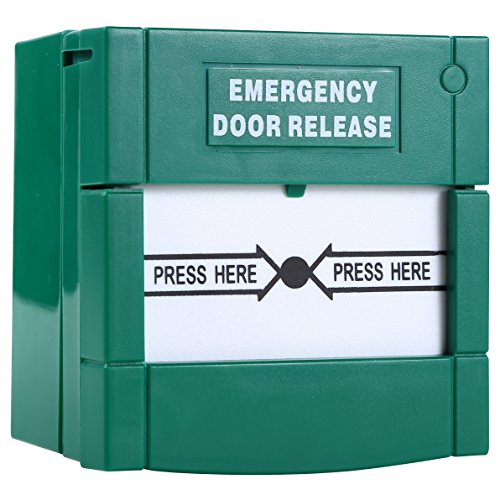
The UHPPOTE unit features a sandblast panel and fireproof material, designed to meet safety standards for safe door release. Its compact dimensions (86x86x56 mm) make it suitable for tight installation spaces. Best for facilities that require a reusable break-glass mechanism after a reset, such as schools or office lobbies. A key consideration is ensuring compatibility with your door hardware and control system.
Who it’s best for: Facilities needing a resettable, durable escape button that remains visible and functional after use.
Why chosen: Combines fireproof materials with a clean, elegant panel suitable for public spaces and high-traffic areas.
Caution: Verify that the electrical wiring and mounting surface comply with local safety codes and door-release standards.
SDC 491-ADI DPDT Emergency Door Release

SDC 491-ADI offers a DPDT (double-pole double-throw) contact configuration that supports both door release and auxiliary monitoring. This unit is well-suited for doors that require additional signaling or interlocking to a monitoring system. It is described as a dual-contact safety device, making it a good choice for facilities with CCTV or alarm integrations.
Who it’s best for: Buildings needing integrated release control with additional monitoring or interlock features.
Why chosen: The device design supports robust control schemes, which can improve safety and traceability in complex access systems.
Caution: Check whether your door controller supports DPDT configurations and whether wiring complexity matches staff capabilities.
UHPPOTE Wired Security Button Hands Break Glass

This wired security button provides a straightforward break-glass release option, designed to assist evacuation personnel in emergencies. It is described as suitable for electrical control or access door systems and works well for public venues. The glass-breaking action is intended to be quick and intuitive, though wiring integrity and mounting must be maintained to ensure reliability during a true emergency.
Who it’s best for: Public-facing spaces or facilities needing a simple, wired release without complex electronics.
Why chosen: Clear activation method and compatibility with standard door control systems make it a practical option for many installations.
Caution: Conduct regular maintenance to ensure the release button remains unobstructed and fully operable.
SDC 490 Series Break Glass Station

SDC 490 combines a blue housing with clear activation instructions to minimize user confusion during emergencies. The station includes aluminum rod hardware for breaking the glass and supports two SPDT 10 Amp contacts plus an additional SPDT for lock release or auxiliary monitoring. This makes it a strong option for facilities seeking easy visibility and reliable signaling.
Who it’s best for: Environments that value readability and straightforward activation under stress, such as classrooms or retail spaces.
Why chosen: Distinct signaling and guidance reduce hesitation during evacuations while enabling remote monitoring and door control.
Caution: The blue housing may be less conspicuous in certain color schemes; ensure color contrast aligns with your safety signage.
Dioche Emergency Door Release Break Glass Alarm Button Switch

Dioche’s model is a flame-retardant, PC material break-glass switch designed for easy installation and compatibility with electrical or access-control systems. It emphasizes evacuation support and is described as simple to mount, with a temperature range suitable for emergency use in varied environments. This option suits spaces needing a robust, flame-retardant construction and straightforward integration.
Who it’s best for: Public buildings and commercial spaces requiring a durable, easily installed alarm-enabled release button.
Why chosen: Balance of flame retardance, clear guidance, and accessible installation makes it a practical pick for general safety deployment.
Caution: Confirm system compatibility with your access control or alarm infrastructure to avoid integration issues.
Buying Guide: Practical Considerations For Emergency Break-Glass Releases
- Activation speed and visibility: Look for clear labeling, color contrast, and easy reach. Blue or red housing with legible instructions helps reduce hesitation during emergencies.
- Electrical wiring and control compatibility: Ensure the device works with your door controller, CCTV, alarms, and access control system. Check DPDT vs SPDT configurations if your setup requires monitoring signals or multiple outputs.
- Materials and fire safety: Fireproof or flame-retardant construction is important in high-heat environments and public spaces. A sandblasted finish can aid visibility while maintaining durability.
- Maintenance and reset capability: Some models are resettable after activation, which is useful for repetitive use scenarios. Understand reset procedures and maintenance schedules.
- Placement and accessibility: Install at compliant mounting heights and ensure unobstructed access for evacuees, including those with mobility challenges.
- Integration with alarms and monitoring: If remote monitoring, CCTV, or alarm systems are involved, verify compatibility and required wiring diagrams before purchase.
Frequently Asked Questions
- What is the difference between DPDT and SPDT in emergency door releases? – DPDT provides dual poles with two separate circuits, enabling more complex monitoring and interlock configurations. SPDT controls a single circuit, suitable for simpler setups.
- Are break-glass buttons fireproof? – Many are designed with fire-retardant materials, but always check product specifications for compliance with local fire safety codes.
- Can these devices be used with existing access control systems? – Yes, most models are designed to integrate with access control or alarm systems, but verify compatibility with your specific hardware.
- Do these releases require professional installation? – Installation difficulty varies; some units are straightforward mounting with standard wiring, while others may need professional electrical work to ensure proper integration.
- Is resettable the best option for all facilities? – Resettable releases reduce downtime after an event, but non-resettable units may be preferred in highly controlled or high-security environments.
- What maintenance is recommended? – Regular inspections, testing of the release mechanism, and ensuring none are obstructed by furniture or signage help maintain reliability.