Precision matters in any scientific setting, from classrooms to professional laboratories. This guide highlights top graduated cylinders that use metric scales for accurate liquid measurements. Each picks emphasizes durability, readability, and reliability to help you choose cylinders that perform well under routine use.
To help you compare quickly, here is a summary table of the selected products. All items feature clear metric graduations, sturdy borosilicate glass or durable plastics, and ready-to-use accuracy for common lab tasks.
| Product | Material | Capacity | Graduations | Key Benefit |
|---|---|---|---|---|
| Karter Scientific 213I11 | Borosilicate Glass 3.3 | 50 ml | 1 ml | Compact and precise for small volumes |
| Karter Scientific 213I12 | Borosilicate Glass 3.3 | 100 ml | 1 ml | Reliable larger-volume option |
| Karter Scientific 246H7 | Borosilicate Glass 3.3 | 50 ml | 1 ml | Pack of 2, cost-efficient |
| Karter Scientific 237O2 | Polypropylene | 1000 ml | Blue printed and molded | Large-volume plastic option |
| Jetec Glass Set | Glass (3.3 borosilicate) | 5–100 ml (set) | Clear graduations | Versatile multi-size kit |
50ml Graduated Cylinder, Karter Scientific 213I11

The Karter Scientific 213I11 offers 50 ml capacity with 1 ml graduations across the scale, making it suitable for precise measurement of small volumes. Constructed from borosilicate glass (class B) with a single metric scale, this cylinder emphasizes clarity and repeatability in routine lab tasks. Its compact form supports easy handling in crowded benches, while the tolerance of ±0.5 ml provides a reliable reading window for standard experiments. This model is ideal for education settings or quick chemistry tasks requiring modest volumes.
Key considerations include the glass type—borosilicate provides chemical resistance and thermal stability—and the single metric scale, which reduces potential reading errors on multi-scale devices. Users should handle with care to preserve the taper and ensure accurate pouring. The 50 ml capacity is well-matched to titrations, sample preparation, and aliquoting workflows where small volumes are frequently needed.
100ml Graduated Cylinder, Karter Scientific 213I12

The 213I12 version enlarges the capacity to 100 ml while retaining 1 ml graduations and a ±1 ml tolerance. This makes it suitable for measuring larger volumes without sacrificing precision. Like its smaller counterpart, it uses borosilicate glass for durability and chemical resistance, with a clean, single metric scale for straightforward readings. The increased volume reduces the need to refill as often during bench-scale experiments, boosting efficiency in labs and classrooms alike.
Considerations for this model include the balance between readability and capacity—readability is preserved by a clear, precisely etched scale, while the larger volume supports more substantial sample preparation. Users should avoid exposure to extreme heat to prevent stress on the glass. Regular cleaning ensures the scale remains legible after multiple uses, which is especially important in educational labs where frequent handling occurs.
50ml Graduated Cylinder, Karter Scientific 246H7 (Pack of 2)

This pack includes two 50 ml cylinders with 1 ml graduations and a tolerance of ±0.5 ml, offering a cost-effective solution for labs that require multiple measuring tools. The borosilicate 3.3 glass construction ensures chemical resistance and durability under standard lab conditions. The dual-pack format supports parallel experiments or backup instruments for busy teaching labs and research setups.
Practical use notes include proper cleaning between uses to avoid cross-contamination and ensuring the glass is not exposed to thermal shocks that can cause microcracking. The straightforward metric scale helps minimize measurement errors in routine tasks such as reagent preparation and sample dilution. This option is particularly appealing for classrooms or small facilities needing dependable, economical glass cylinders.
1000ml Plastic Graduated Cylinder, Karter Scientific 237O2

The 1000 ml polypropylene cylinder in the 237O2 line uses a single metric scale with blue printed and molded graduations. This larger-volume instrument is ideal for bulk liquid handling, reagent preparation, and processes where glass is undesired due to breakage risk or chemical compatibility concerns. Polypropylene offers chemical resistance in many settings and can endure repeated use in busy labs. The plastic construction makes these cylinders lighter and less prone to shattering than glass, though care should be taken to maintain accuracy, as plastic scales can wear with heavy use.
Choose this option when a higher-volume, durable instrument is needed, particularly in educational labs or field stations where accidents are more likely. Calibration should be checked periodically, and any signs of scale wear should prompt replacement to maintain measurement integrity. For classroom environments, this cylinder also reduces the risk of injury and simplifies maintenance while still providing reliable metric readings.
Ronyes Lifescience 100 mL Glass Cylinder (Pack of 2)
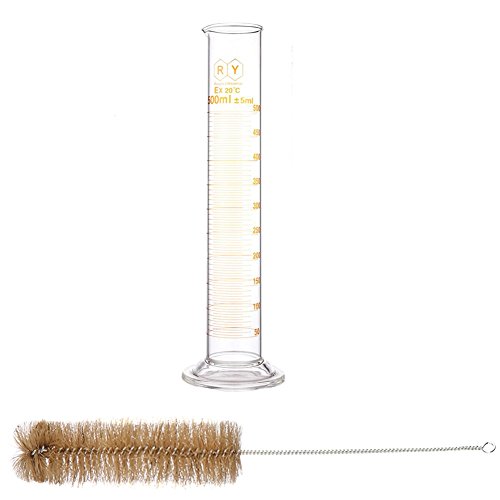
This product line offers a 100 ml glass cylinder with a single metric scale and a robust design intended for repeated use. The set includes two units to support parallel experiments or provide backup instruments in busy environments. The features emphasize readability and accuracy with orange graduations marking the main points for quick visual reference. The borosilicate glass is described as food-safe and alcohol-resistant, and cleaning is straightforward. The design aims to balance durability with precise measurement for general lab work and teaching demonstrations.
Practical considerations include ensuring compatibility with your reagents and avoiding aggressive solvents that could degrade glass over time. Users should inspect the cylinder for wear on the scale and verify calibration periodically. This pack is well-suited for labs that require multiple measurement devices while maintaining consistent metric readings across instruments.
Jetec 10 Pcs Thick Glass Cylinder Set
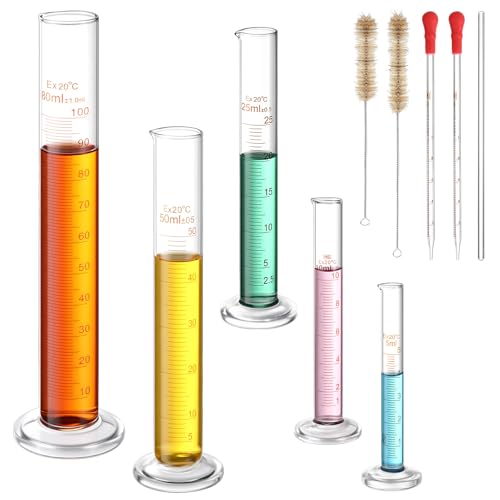
The Jetec set provides an assortment of five cylinders ranging from 5 ml to 100 ml, plus two brushes, two droppers, and a stirring rod. The cylinders are made from glass with clear scale lines for easy reading, and they feature a wide edge and tapered pouring mouth to facilitate transfer. While suitable for general measurement tasks, the glass is not rated for heating liquids, so operators should avoid exposing these cylinders to high temperatures. This kit is especially useful for education and small labs needing multiple sizes in one package.
The multi-size approach allows users to standardize procedures across varying volumes, which can improve consistency in experiments. The included tools support cleaning and liquid handling, contributing to efficient workflow in teaching labs or hobbyist setups where metric accuracy is essential.
Buying Guide: Key Considerations For Choosing Metric Graduated Cylinders
When selecting graduated cylinders by metric units, consider these factors to compare effectively and choose the best fit for your needs:
- Material and durability: Borosilicate glass (3.3) offers chemical resistance and heat tolerance, ideal for standard lab tasks. Polypropylene provides higher impact resistance and is suitable where glass breakage is a concern.
- Capacity and graduations: Choose a size that matches your typical volumes. Common options include 50 ml and 100 ml with 1 ml graduations for precise readings; larger volumes like 1000 ml are useful for bulk liquids.
- Tolerance: Smaller tolerances (e.g., ±0.5 ml) enable tighter measurement control, whereas larger tolerances are acceptable for roughings or educational demonstrations.
- Readability: Clear, etched or printed scales reduce parallax errors. Some sets use colored or blue markings to highlight key measurements.
- Maintenance: Glass cylinders require careful handling and occasional cleaning to preserve scale readability. Plastic cylinders reduce breakage risk but may wear with heavy use.
- Kit contents: Sets with multiple sizes and accessories (brushes, droppers, stirring rods) offer value and versatility for classrooms or busy labs.
- Use context: Educational environments prioritize safety and ease of use, while research labs may demand higher precision, durability, and chemical compatibility.
In practice, buyers often balance price, durability, and accuracy. For frequent volume transfers, a mix of a few 50–100 ml glass cylinders with one large-volume plastic cylinder can cover most tasks. If you regularly handle aggressive solvents or drop-prone settings, prioritize thicker glass or plastic options with robust scale markings. Always verify that the graduation scale aligns with your typical measurement increments to minimize manual calculation errors during experiments.