If you’re shopping for reliable plastic petri dishes with lids, these options are designed for science classrooms, hobby labs, and home experiments. This guide highlights five top picks, explaining who each product is best for and why. Use this overview to compare sizes, sterility, and build quality without guessing. The table below provides quick reference data on the featured items to help you decide faster.
| Product | Diameter x Depth | Included | Best For |
|---|---|---|---|
| Qiuttnqn 30 Pack 90 x 15mm | 90 x 15 mm | 30 Dishes with Lids | School science projects and basic lab work |
| Vabiooth 10 Pack 90mm | 90 x 15 mm | 10 Dishes with Lids, 3 vents | Introductory experiments and small-scale studies |
| Qiuttnqn 60 Pack 60 x 15mm | 60 x 15 mm | 60 Dishes with Lids | Classroom activities and routine culture work |
| Vabiooth 100 Packs 90mm | 90 x 15 mm | 100 Dishes with Lids | Larger projects and ongoing experiments |
| Kingdder 200 Pack 90mm | 90 x 15 mm | 200 Dishes with Lids | Bulk classroom labs and repetitive tasks |
Qiuttnqn 30 Pack Plastic Petri Dishes with Lids

Diameter 90 mm, depth 15 mm. This 30-pack set uses clear plastic dishes with lids, designed for school science projects and basic lab analysis. The dishes are described as smooth-surfaced, easy to clean, and reusable, making them suitable for light repeated use in classroom contexts. Best for: teachers and students conducting introductory microbiology or seeding activities where long-term sterility is not required. Caution: not autoclavable; avoid exposure to high heat to prevent deformation.
Vabiooth 10 Pack Sterile Petri Dishes with Lid

Diameter 90 mm, depth 15 mm. This 10-pack set emphasizes sterility, with EO sterilization and three-vented lids to improve air circulation and reduce condensation. It’s heavier (listed at 16 g per dish) than some competitors, indicating a thicker, more durable plastic. Best for: basic microbiology demonstrations, student-led experiments, and projects where sterility is preferred. Caution: not heat-safe above about 120°F; autoclavable models are available if needed.
Qiuttnqn 60 Pack Plastic Petri Dishes with Lids

Diameter 60 mm, depth 15 mm. This bundle provides 60 smaller dishes, ideal for compact projects, multi-sample experiments, or classroom demonstrations where space is limited. Best for: quick-seeded cultures, small-scale observations, and STEM activities requiring a larger quantity of shallow dishes. Caution: not suitable for heating above recommended temperatures; consider autoclavable options for high-temperature needs.
Kingdder 200 Pack 90mm Petri Dishes with Lids
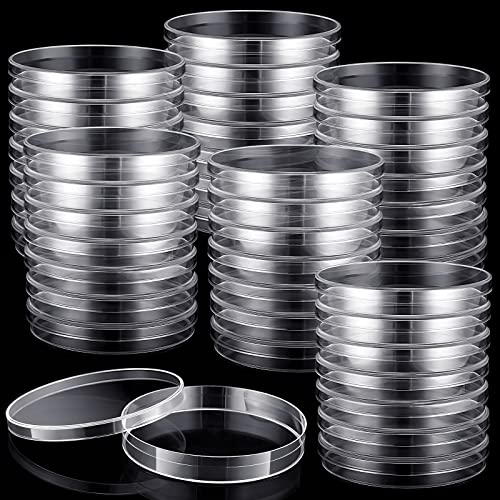
Diameter 90 mm, depth 15 mm. The 200-pack bulk option emphasizes quantity for ongoing labs and large classes. The dishes are described as solid, thick, and clear for easy microscopic examination. Best for: bulk education settings, long-term projects, and labs that require frequent dish replacement. Caution: avoid heating above 120°F; reduce waste by reusing when permissible and safe.
Buying Guide
Size and fit: Choose diameter and depth that match your experiment needs. Larger dishes (90 mm) are better for visible colonies and teaching demonstrations; smaller dishes (60 mm) save space for multi-sample layouts.
Sterility and disposal: For sterile work, look for pre-sterilized options with clear storage instructions. If you require autoclavable dishes, search for models explicitly labeled as autoclavable.
Lid design: 3-vented lids support gas exchange and reduce condensation, which helps with growth studies. Non-vented lids can be suitable for short-term storage and observation.
Material and durability: Thicker plastics often indicate greater durability and reduced cracking during handling. Balance cost against the expected reuse frequency in busy classrooms or labs.
Intended use: Basic classroom activities may tolerate reusable, lower-cost dishes. For microbiology demonstrations or mycology projects, prioritize sterile, pre-bagged, or EO-sterilized options.
Storage and space: If space is limited, consider smaller sets or bulk quantities with a stackable, space-saving design. Lidded dishes help minimize contamination when stored between sessions.
FAQ
- Are plastic petri dishes with lids reusable?
Many are reusable if properly cleaned; however, some are designed for single-use or limited reuse to maintain sterility. - Can these dishes be heated or autoclaved?
Most of the listed options caution against heating beyond about 120°F. Autoclavable variants are available separately; verify product labeling. - Which size is best for classrooms?
60 mm and 90 mm dishes cover a broad range of activities. 60 mm saves space for multi-sample layouts; 90 mm offers easier observation of growth patterns. - What does “3 vents” on the lid mean for experiments?
Three-vented lids improve air exchange and reduce condensation, beneficial for microbial growth studies. - Is EO sterilization enough for classroom use?
Ethylene oxide (EO) sterilization is a common method ensuring initial sterility suitable for education and basic experiments. - What should I consider when buying in bulk?
Bulk purchases are cost-effective for large classes or long-term projects; ensure the dishes are stackable and compatible with your storage space.