If you’re looking to slow down door closing for safety, energy savings, and quiet operation, you’ve found a practical guide. This article highlights five reliable door closers suitable for homes, offices, and light commercial spaces. Each pick is described with who it’s best for, why it was selected, and a clear limitation to keep in mind. Whether you need a hydraulic, pneumatic, or spring-based closer, the right option will reduce slam, protect frames, and simplify daily use for families and busy workplaces alike.
| Product | Best For | Key Benefit |
|---|---|---|
| FORTSTRONG Automatic Door Closer FS-1306 | Residential interior doors | UL listed, adjustable swing and closure speeds |
| Greenstar Touch ‘n Hold Smooth Door Closer | Storm or screen doors | Hands-free hold-open with smooth closing |
| Wright Products Heavy-Duty Pneumatic Closer | Medium-to-heavy storm doors | Quiet, adjustable closing with hold-open |
| GOOKYO Door Closer Automatic Safety Spring | Lightweight doors that need quick retrofit | Easy DIY installation, left/right handed |
| Amazon Basics Self-Closing Door Hinge | Standard interior doors | Simple hinge solution for self-closing |
FORTSTRONG Automatic Door Closer FS-1306 (Residential)

Best for: Home interiors and interior garage doors where reliable self-closing is needed. This UL-listed hydraulic closer supports doors between 88 and 143 pounds and is suitable for left or right-handed installations. It offers two independent valves to adjust swing speed and closure speed, plus a fully adjustable arm. The unit is designed for enduring performance in everyday home use, helping conserve energy and improve security by keeping doors closed when needed. A potential limitation is that larger or unconventional doors may require checking weight compatibility and mounting requirements before installation.
Greenstar Touch ‘n Hold Smooth Door Closer

Best for: Medium- and lightweight storm or screen doors where hands-free operation is beneficial. This closer features a touch-button hold-open function and a smooth closing action that minimizes bounce. It’s easy to release and reuse, making it practical for doors that need occasional fixed open positions. A limitation to note is that holding open can be unintentionally engaged if the hold button is pressed during closure; avoid this by using the release mechanism properly.
Wright Products Heavy-Duty Pneumatic Storm Door Closer

Best for: Heavy-duty out-swing doors where reliable, quiet closing is important. This unit uses a pneumatic tube and internal lubricated spring to deliver smooth, slam-free operation. It includes an easy thumbscrew for closing-speed adjustment and a hold-open feature. A potential limitation is that very lightweight interior doors may not benefit as much from heavy-duty hardware, so matching door weight to the closer is advised.
GOOKYO Door Closer Automatic Safety Spring

Best for: Lightweight doors needing a quick retrofit to self-close. This zinc-alloy spring closer provides automatic closing and is described as easy to install. It supports doors up to about 150 pounds and works on both left- and right-handed doors. A caution: spring tension may require careful adjustment to avoid over-tight closing or insufficient closure for heavier doors.
Amazon Basics Self-Closing Door Hinge

Best for: Standard interior doors where a simple hinge-based self-closing solution is desired. This satin nickel hinge is designed for standard 1-3/8-inch doors and provides a straightforward, ready-to-install self-closing option. A limitation is that hinge-based closures can be less adjustable than dedicated door closers, which may reduce long-term customization for unique door weights.
Wright Products Standard Duty Pneumatic Closer

Best for: Light to medium-weight storm, screen, or security doors used daily. It features adjustable closing speed and a built-in, air-pressurized mechanism to prevent slams. The unit is easy to install and designed for reliable everyday use. Consider that very heavy doors may require a more robust model for maximum performance.
OAKMOORE Commercial Heavy-Duty Automatic Door Closer
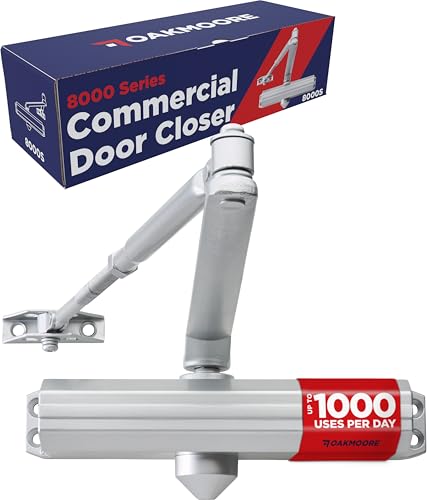
Best for: High-traffic commercial doors requiring precise control and soft-close action. This ADA UL Grade 1 listed closer integrates pneumatic and hydraulic technologies for smooth operation and a true no-slam experience. It offers dual valves to fine-tune sweep and latch speeds. The main limitation is that installation and adjustment may require more attention in commercial door frames and mounting configurations.
Buying Guide: Key Considerations For Choosing A Door Closer
- Door type and weight: Match the closer’s weight range and mounting style to your door’s dimensions and material (wood, metal, fiberglass).
- Closing speed and latching: Determine whether you need full customization of swing, closing, and latch speeds for your space.
- Hold-open feature: Decide if you need a hold-open option for traffic flow, safety, or accessibility requirements.
- Spare parts and installation: Consider products with simple mounting hardware and easy-to-adjust valves; DIY-friendly options can save time.
- Noise and slam protection: Pneumatic or hydraulic systems typically dampen closing to reduce noise and impact on doors and frames.
- Durability and usage: For high-traffic areas, prioritize heavy-duty models with robust materials and certifications.
- ADA and safety compliance: If accessibility matters, select models with ADA compatibility and UL or equivalent listings.
Frequently Asked Questions
- What is the main difference between hydraulic and pneumatic door closers?
– Hydraulic closers use fluid-filled chambers for controlled motion, while pneumatic closers use air pressure for cushioning and speed control. - Do all door closers require professional installation?
– Many residential models are DIY-friendly, but some commercial or high-traffic installations may benefit from professional mounting and adjustment. - Can door closers be tuned for both left- and right-handed doors?
– Yes, several models support both orientations with adjustable arms or reversible mounting. - Is a hold-open feature necessary for every doorway?
– Not always; hold-open is convenient for frequent traffic flow but can be a nuisance in some settings if accidentally engaged. - Will a closer affect door hardware longevity?
– Properly matched, installed, and adjusted closers reduce wear by minimizing slams and sudden impacts on frames. - Are these closers compliant with accessibility standards?
– Some models are designed with ADA considerations; verify listings and specifications for your project.