Answering the common buyer question, these solar powered fish pumps provide reliable oxygenation for ponds, fish tanks, and hydroponics without mains electricity. They’re best for small outdoor ponds, backyard water features, or portable setups where wiring isn’t feasible. Below are five well-suited options, highlighting who they’re best for and why each is a good fit. A quick buying table follows to compare core specs at a glance.
| Product | Best For | Key Advantage |
|---|---|---|
| POPOSOAP 3W Solar Pond Aerator | Small yards ponds, hydroponics | Separated solar design with 2200 mAh battery backup |
| POPOSOAP 4W Solar Pond Aerator | Smaller outdoor ponds needing stronger airflow | Higher wattage with same battery backup and 3 modes |
| NFESOLAR 3W Solar Pond Aerator | Quiet operation in small ponds | All-in-one unit with 2200 mAh battery, 3 modes |
| Biling Solar Aerator | Weather-impacted environments | IPX5 waterproof, glass-covered solar panel for efficiency |
| NFESOLAR 4W Solar Pond Aerator | Medium-small ponds and tanks | All-in-one 2200 mAh battery, 3 modes, quiet |
POPOSOAP 3W Solar Pond Aerator

Best for compact outdoor ponds and hydroponics systems, this unit uses a separated solar panel from the air pump, reducing water contact risk and simplifying placement. The built-in 2200 mAh battery backup keeps oxygen flowing during cloudy periods or nighttime. Three operating modes—strong, soft, and cycle bubble—allow seasonal adjustment to maintain healthy dissolved oxygen levels. Best for owners who value wire-free installation and a flexible mode set for summer and winter needs. Caution: While the panel is separated, ensure the panel remains in direct sun for maximum efficiency.
POPOSOAP 4W Solar Pond Aerator

This model follows the same separated solar design and 2200 mAh battery backup but with higher wattage for stronger aeration. It’s ideal for slightly larger small ponds or water features where more bubbles are beneficial. The three modes—strong, soft, and cycle bubble—support year-round pond maintenance. Best for pond owners who need more airflow without adding complexity. Limitation: Higher wattage can increase solar draw, so optimal sun exposure is important.
NFESOLAR 3W Solar Pond Aerator

Best for quiet operation in small ponds and fish tanks, this all-in-one solar aerator includes a 2200 mAh battery backup and three adjustable modes. Its 24/7 oxygenation capability supports continuous water quality improvement, even during overcast days. Choose this if you want a straightforward, all-in-one unit with reliable night-time performance. Caution: The 24/7 claim depends on battery performance and sun conditions; in heavy cloud cover, runtime may vary.
Biling Solar Aerator for Pond

Best for outdoor use with several weather conditions, this unit includes three modes—strong, soft, and 10-second on/off—and an IPX5 waterproof rating. The upgraded glass-covered solar panel enhances energy conversion and longevity, making it a solid choice for ponds, aquariums, or hydroponics setups that face inconsistent sunlight. Better for areas with variable sun exposure. Limitation: IPX5 waterproofing protects against spray and light rain but is not submersible underwater for long periods.
NFESOLAR 4W Solar Pond Aerator
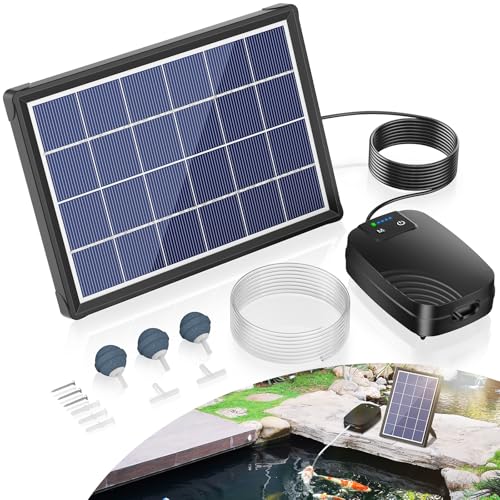
Best for small to medium ponds or fish tanks needing robust aeration, this all-in-one unit features a 2200 mAh battery backup and three operating modes, including a 10s on/off cycle for cloudy or rainy days. It emphasizes stable bubbles and increased dissolved oxygen, supporting fish vitality and water quality. Choose this if you want reliable performance with a quiet operation profile. Limitation: As with all solar pumps, performance depends on sun exposure and battery charge cycles.
Buying Guide: How to Choose a Solar Pond Aerator
- Power and battery capacity: Look for a model with built-in battery backup (commonly 1800–3000 mAh). A larger battery helps sustain oxygenation during cloudy days and night hours.
- Separation of panel and pump: Separated designs prevent water contact with wiring, improving safety and placement flexibility.
- Airflow and modes: Three modes are common (strong, soft, cycle). Consider seasonal needs; stronger bubbles in summer, gentler or intermittent settings in winter or cloudy days.
- Waterproofing and durability: IPX rating indicates water resistance. For outdoor use, IPX5 or better is desirable; ensure the unit is designed for outdoor environments and potential splashes.
- Panel quality: Glass-covered panels are typically more durable and efficient than standard materials, extending panel life and energy conversion.
- Size and suitability: Match pump wattage and air output to pond size. Overpowered pumps may unnecessarily drain the battery; underpowered units may under-oxygenate.
- Ease of installation: Consider whether the unit is truly wire-free or requires cords. Separated panels require distance between components for optimal sun exposure.
- Maintenance: Look for anti-clogging features or easy cleaning processes to reduce downtime and prolong pump life.
Frequently Asked Questions
- How long will a solar pond aerator run at night?
Answer: Battery backup supports nighttime operation dependent on battery capacity and sunlight the previous day. - Do solar aerators require direct sunlight?
Answer: Yes, to charge the panel; partial shade can reduce efficiency and runtimes. - Can I use these in winter?
Answer: Many models offer cycle or softer modes to extend runtime during shorter daylight periods; check each unit’s mode options. - Are separated solar panels safer for ponds?
Answer: Yes, separated designs reduce direct wiring exposure to water, lowering risk. - What pond size is appropriate for these pumps?
Answer: The listed models target small to medium ponds, fish tanks, or hydroponic setups; larger ponds may require higher wattage or multiple units. - What maintenance is needed?
Answer: Regularly inspect hoses and vents, clean filters, and keep panels free of debris to maintain airflow and efficiency.