If you need to treat a stinging-insect nest, choose a product labeled for the specific insect and location—not a general spray to kill bees. Carpenter bee and wasp sprays target different pests, while a natural-oil product may be intended to deter insects rather than kill them. The options below include a carpenter bee treatment, long-range wasp sprays, and an outdoor repellent. Honeybees and other pollinators are beneficial, so avoid spraying them; if you cannot identify the insect or the nest is difficult to reach, contact a pest professional.
| Product | Best For | Notable Feature |
|---|---|---|
| Spectracide Carpenter Bee & Ground-Nesting Yellowjacket Killer | Carpenter bee tunnels | Expanding foam and extension tube |
| Raid Wasp & Hornet Killer | Outdoor stinging-insect nests | Sprays up to 22 feet |
| Spectracide Foaming Wasp & Hornet Killer | Wasp and hornet nests | Jet spray up to 27 feet |
| Wondercide Wasp and Hornet Killer | Open-faced hives and outdoor areas | 15-foot jet spray |
| Exterminators Choice Bee Spray | Outdoor deterrence | Essential-oil formula |
Spectracide Carpenter Bee and Yellowjacket Killer
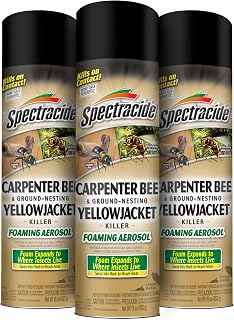
Best for: Treating active carpenter bee tunnels or ground-nesting yellowjacket holes. This three-pack uses expanding foam intended to reach insects where they live, and an extension tube helps direct spray into hard-to-reach openings.
It stands out among these options because its listed uses specifically include carpenter bee tunnels, rather than only wasp and hornet nests. The product also directs users to apply foam into holes where yellowjacket activity has been observed.
Limitation: This is a targeted nest treatment, not a general-purpose spray for flying bees. Use only as directed on the product label, and avoid treating pollinators or unidentified insects.
Raid Wasp and Hornet Killer
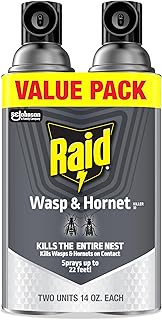
Best for: People treating an outdoor nest of listed stinging insects from a distance. The two 14-ounce cans are described as killing paper wasps, yellow jackets, mud daubers, bald-faced hornets, and other flying stinging insects on contact. The spray reaches up to 22 feet, according to the product details.
Choose this if the target is a listed wasp or hornet and distance from the nest is an important consideration. Its features also state that the spray is electrically non-conducting up to 32,500 volts; that specification does not replace label directions or safe handling around electrical equipment.
Limitation: The listed uses do not identify it as a carpenter bee treatment. Avoid using it on bees that are not the target pest.
Spectracide Foaming Wasp and Hornet Killer

Best for: Treating nests of wasps, hornets, or yellowjackets when a longer-range jet is useful. The product comes in a three-pack and is described as killing listed pests by contact. Its spray reaches up to 27 feet, farther than the stated range for the Raid option above.
The blanketing foam is intended to cover the target area, while the water-based formula is described as non-staining and as leaving no oily residue. Choose this if you want a foaming product with a stated long-distance spray range.
Limitation: Its listed target pests are wasps, hornets, and yellowjackets, not carpenter bees. Confirm the insect and nest type before treating.
Wondercide Wasp and Hornet Killer Aerosol

Best for: Outdoor wasp, hornet, and yellowjacket control, including open-faced hives. This two-pack has a 15-foot jet spray and is described as providing contact kill and fast knockdown. The listed outdoor areas include porches, patios, decks, and playscapes.
Choose this if you want an aerosol specifically described for open-faced hives and outdoor spaces. Its product information says it can be used around children and pets when used as directed. Read and follow the label carefully; that statement is not permission to expose people or animals to wet spray.
Limitation: The stated spray range is shorter than those listed for the two Spectracide and Raid products. It is not identified as a carpenter bee treatment.
Exterminators Choice Bee and Wasp Spray

Best for: People looking for an outdoor deterrent around patios, gardens, sheds, decks, gazebos, and windows. This 32-ounce product lists peppermint, white pepper, and cinnamon oils as ingredients and is positioned as helping keep bees and wasps away.
Choose this when the goal is to discourage nesting or insect activity rather than treat an active nest with a contact-kill product. Its listed features describe use around children and pets when applied as instructed.
Limitation: The product is described as helping keep insects away, not as a guaranteed way to eliminate a nest. It is not interchangeable with a labeled nest-killing treatment.
Buying Guide: How to Choose a Bee or Wasp Spray
What insect are you trying to manage?
Identify the insect before choosing a product. Carpenter bees make tunnels in wood, while yellowjackets may nest underground; wasps and hornets can build visible nests. The products above list different target pests, so select one whose label specifically covers the insect and location. If you are unsure whether the insects are honeybees, wasps, or another species, avoid spraying until they are identified.
Do you need nest treatment or deterrence?
For a nest, use a product labeled for that pest and nest type. The Spectracide carpenter bee option is specifically described for tunnels, while the other contact-kill sprays list wasps, hornets, or yellowjackets. Exterminators Choice is presented as a deterrent. Do not assume a repellent will eliminate an active nest.
How important is spray distance?
Compare the stated ranges: Spectracide Foaming Wasp & Hornet Killer reaches up to 27 feet, Raid up to 22 feet, and Wondercide up to 15 feet. A longer range may allow more distance from a nest, but it does not make treatment risk-free. Follow label instructions and do not spray from a position that leaves no safe way to retreat.
When should you call a professional?
Contact a pest professional if a nest is inside a wall, high above the ground, difficult to reach, or near people who may be stung. Professional advice is also sensible when the insect is unidentified or may be a pollinator. Follow local guidance for bee removal, and do not destroy honeybee colonies without checking whether relocation is appropriate.
Frequently Asked Questions
Can I use wasp spray to kill bees?
Do not assume a wasp spray is appropriate for bees. Check the product label for the specific target insect, and avoid spraying honeybees or other beneficial pollinators.
Which option is listed for carpenter bee tunnels?
Spectracide Carpenter Bee & Ground-Nesting Yellowjacket Killer specifically lists treatment of active carpenter bee tunnels and includes an extension tube.
Which listed spray has the longest range?
Spectracide Foaming Wasp & Hornet Killer lists a spray range of up to 27 feet. Actual use should follow the product label.
Does a bee deterrent kill an active nest?
Not necessarily. Exterminators Choice is described as helping keep bees and wasps away; its listed features do not promise nest elimination.
Is it safe to spray near children and pets?
Product directions differ. Keep children and pets away during application and follow all label instructions, including any directions about treated areas and re-entry.