For film enthusiasts and memory keepers, turning Super 8 and 8mm reels into clean, viewable digital files is essential. This guide highlights five dependable options designed for different needs—from large-screen viewing to simple, offline archiving. Each pick targets a specific buyer: hobbyists seeking simple transfers, hobbyists who want built-in screens, enthusiasts prioritizing high resolution, and those who want a balance of ease and flexibility. Below, you’ll find concise comparisons, practical pros and cons, and a practical buying table to help you decide at a glance.
| Product | Best For | Key Benefit |
|---|---|---|
| KODAK REELS 8mm & Super 8 Films Digitizer | All-in-one digitizing with a big display | Frame-by-frame digitizing on a 5″ LCD |
| eyesen 8mm & Super 8 Film to Digital Converter | Simple, offline transfers | 2.4″ LCD with SD card saves up to 32GB |
| Kodak SCANZA Digital Film & Slide Scanner | Versatile film formats, quick JPEGs | 3.5″ LCD and multi-film inserts |
| Magnasonic All-in-One 24MP Film Scanner | High-resolution digital photos from film | Built-in memory and SD expansion |
| Magnasonic Super 8/8mm Film Scanner (FS81) | Compact, budget-friendly video flips | 2.3″ screen, direct SD storage |
KODAK REELS 8mm & Super 8 Films Digitizer

The Kodak REELS Digitizer is an all-in-one unit that converts 3″, 5″, 7″, 8″ and 9″ reels frame-by-frame into digital MP4 files. It features a large 5″ onboard LCD, oversize controls, and a simple, guided workflow. Best for hobbyists who want a self-contained device without a computer. A built-in frame-by-frame process supports careful frame selection, with easy transfer to an SD card. A limitation to watch for is that audio is not included in output videos.
Who this is for: learners and collectors who value a touch-screen experience and a standalone workflow for quick viewing on big screens. Why selected: it combines automated scanning, clear UI, and broad reel compatibility in one package.
Caution: No sound is recorded in the output MP4 files, so the final videos will be silent unless you add audio separately in a different workflow.
8mm & Super 8 Film to Digital Converter (eyesen)

eyesen’s 8mm & Super 8 Film to Digital Converter offers fully automated digitizing with a built-in 2.4″ LCD and included SD card up to 32GB. It supports reels up to 9″ and produces 1080P MP4 files. The device is designed for users who want straightforward, no-software transfers directly to SD cards. It lacks on-device editing, so post-processing may require a computer or viewer. Best for: casual users who want a compact, self-contained solution.
Selected for its compact form and explicit “no computer required” workflow. Choose this if you want a budget-friendly, plug-and-play option with clear results.
Caution: Output is video-only; if you need enhanced color or sound, plan to do post-processing separately on a computer.
Kodak SCANZA Digital Film & Slide Scanner
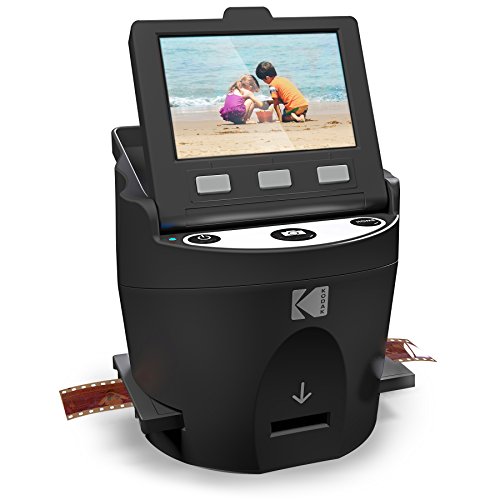
The SCANZA is a versatile film-to-digital scanner capable of handling 35mm, 126, 110, Super 8, and 8mm film. It outputs JPEGs quickly on a bright 3.5″ LCD screen. It ships with adapters for different film sizes and emphasizes fast, one-step scans. Best for: users who need to digitize mixed-format collections in a single device. Why selected: strong format support and an intuitive interface help reduce the setup time for varied reels.
Caution: Not designed to handle large film libraries in a single batch; it’s optimized for individual or small-quantity scans.
Magnasonic All-in-One 24MP Film Scanner

Magnasonic’s 24MP All-in-One Scanner provides a robust 24MP resolution for film negatives and slides, with a 5″ LCD for direct viewing. It offers built-in memory and an SD card slot up to 128GB, making it easy to save large batches of digital photos. Best for: archivists who value high image quality and flexible viewing. Why selected: high resolution output and convenient on-device viewing simplify the transfer of extensive photo collections.
Limitation: While excellent for photos, some users may prefer additional color controls or denoise options in dedicated software for peak archival quality.
Magnasonic Super 8/8mm Film Scanner (FS81)
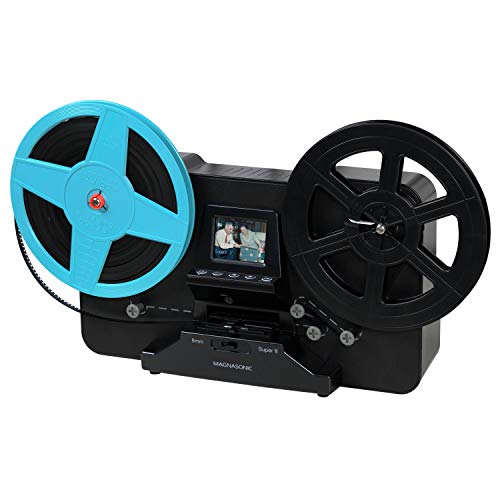
The Magnasonic FS81 specializes in converting 3″, 5″, and 7″ reels of Super 8/8mm into digital MP4 videos, with a built-in 2.3″ LCD for immediate playback. It outputs to an SD card (not included) and supports quick, front-facing scans. Best for: collectors who want quick digitization with a small footprint. Why selected: compact design and straightforward operation make it ideal for shelf-space-limited setups.
Caution: It records video only (no audio), so consider separate audio capture when needed for fuller playback experiences.
Buying Guide
What to consider when digitizing Super 8 and 8mm film
- Format compatibility: Ensure the device accepts your reel sizes (3″, 5″, 7″, 8″ or 9″).
- Output resolution: Higher MP/1080p yields clearer frames; balance with device price and storage.
- Built-in screen vs. external viewing: Onboard displays speed setup; external TV/monitor viewing provides larger playback.
- Storage options: SD/SDHC capacity and internal memory determine how many reels you can digitize before transferring.
- Sound: Some devices output silent video. If soundtracks matter, plan for post-processing or different equipment with audio capture.
- Ease of use: Fully automated digitizers save time; manual framing is better for precise frame selection.
- Future-proofing: Consider devices that allow easy transfer to computers or TVs, and support standard MP4/JPEG formats for long-term compatibility.
Frequently Asked Questions
Can I get sound from Super 8 digitized films?
Most standalone film digitizers produce silent MP4s. You may need to add audio separately in post-processing or use a device that supports separate soundtrack capture.
Do these devices require a computer?
Several options work without a computer, directly saving to SD cards. Others offer computer transfer for additional editing and storage management.
What film sizes do these devices support?
Look for models supporting common reel sizes such as 3″, 5″, 7″, 8″, and 9″. Some units may need adapters for certain formats.
Is 1080p sufficient for archival quality?
1080p provides clear results for most viewers and preserves detail. For highly archival projects, consider higher-resolution scanners if available or perform color correction in post-processing.
Which device is best for mixed-format collections?
A versatile scanner with adapters for multiple formats (such as 35mm, 126, 110, Super 8, and 8mm) is preferable. The Kodak SCANZA stands out for this use due to its broad format support.