For researchers, students, crafters, and hobbyists who need reliable glass and plastic test tubes with stoppers, this guide highlights five well-suited options. Each pick balances durability, capacity, and sealing performance to fit common tasks like sample storage, mixing, or classroom demonstrations. The selections range from durable borosilicate glass to shatter-resistant plastics, so you can choose based on breakage risk, heat exposure, and storage needs. The table below offers at-a-glance comparisons to help you decide quickly.
| Product | Material | Key Capacity | Best For |
|---|---|---|---|
| 16X150mm Glass Test Tubes with Rubber Stoppers (Karter Scientific 201B5) | Glass | 23 ml | General chemistry and education, when you want sturdy glass |
| 20x150mm Glass Test Tube Set with Rubber Stoppers and Rack (Karter Scientific 150A3) | Glass | ~36 ml | Inline rack storage and multiple samples |
| 15x100mm Plastic Test Tubes with Lids (Mozeat Lens) | Plastic | 15 ml | Breakage-prone environments, lightweight storage |
| 10-Pack Glass Test Tubes with Rubber Stoppers (Ronyes Lifescience) | Glass | 36 ml | Reliable sealing for liquids and samples |
| 30 ml Glass Test Tubes with Cork Stoppers (Cadbibe) | Glass | 30 ml | Temperature variation experiments and reuse |
16X150mm Glass Test Tubes With Rubber Stoppers

Best for: classrooms, basic lab work, and beginners who need a dependable glass option. The 6-inch tall tubes with 0.63-inch (20 mm) width and 23 ml capacity provide a balanced option for simple reactions, storage, or demonstration experiments. Rubber stoppers offer a tight seal to minimize leakage during transfers. Caution: Handle glass with care to avoid chips or cracks during handling or centrifugation.
20x150mm Glass Test Tube Set with Stoppers and Rack
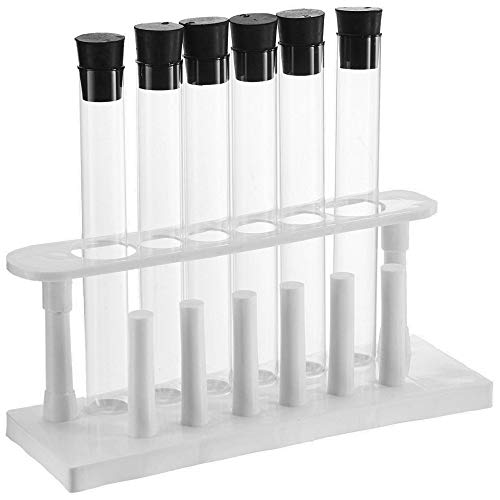
Best for: small-scale experiments and organization. This set includes a six-placer rack and inline, drying, white rack construction, keeping tubes neatly arranged. Tubes measure 19.6 mm outer diameter and 18.0 mm inner diameter, with black rubber stoppers. Caution: The included rack is a flat arrangement—ensure you have space for drying and storage in your workspace.
15x100mm Plastic Test Tubes With Lids

Best for: non-breakable storage and quick-access labeling. The 15-pack package features transparent plastic tubes with cork-like caps, offering lightweight handling and reusability. Size is 1.5 cm in diameter and 10 cm long, with 15 ml capacity. Caution: Plastic may be prone to scratching or surface damage over time, and heat exposure should be managed according to plastic type compatibility.
10-Pack Glass Test Tubes With Rubber Stoppers

Best for: value-focused users needing consistent glass quality and a compact pack. Each tube is 150 mm long with a 20 mm diameter and 36 ml capacity, providing ample room for mixtures without crowding. Rubber stoppers offer reliable seals. Caution: As glass, these can break if dropped or mishandled; use sturdy racks and avoid sudden temperature shifts.
6PCS 30ml Glass Test Tubes With Cork Stoppers

Best for: medium-capacity experiments and storage where cork stoppers are preferred. Tubes measure 30×70 mm with a 30 ml capacity and borosilicate glass that tolerates wide temperature ranges. They are reusable after cleaning. Caution: Cork stoppers can absorb liquids; ensure complete drying to avoid contamination or stopper degradation over time.
Buying Guide: Key Considerations For Test Tubes With Stoppers
- Material choice: Glass provides chemical resistance and heat tolerance but is breakable; plastic offers durability and lightness but may have lower temperature tolerance or chemical compatibility.
- Seal type: Rubber stoppers give good seals for liquids; cork stoppers suit dry or low-heat applications, but may require regular replacement if they degrade.
- Volume and dimensions: Match capacity to your typical samples. Consider outer diameter and length to fit your racks, stands, and storage space.
- Temperature exposure: Borosilicate glass handles extreme temperatures; ensure plastic options list appropriate temperature limits for your use.
- Storage and organization: Racks and inline arrangements help manage multiple tubes during experiments or demonstrations.
- Reusability and cleaning: Glass is often reusable after proper cleaning; plastics may require gentle handling to avoid scratching or micro-cracks.
Frequently Asked Questions
- What material is most resistant to breakage?
Plastic tubes are less prone to breakage than glass, making them suitable for environments with drops or rough handling. - Are cork stoppers compatible with liquids?
Corks can seal well for certain liquids but may degrade with moisture or strong solvents; check chemical compatibility for your use. - Which size is best for classroom demonstrations?
Around 15–30 ml tubes with clear labeling and easy sealing are ideal for demonstrations and small-scale experiments. - Can glass tubes be heated and cooled repeatedly?
Yes, if they are borosilicate glass; avoid rapid temperature changes that could cause cracking. - Do tubes come with racks?
Some sets include racks (like inline or six-placer racks); if racks are essential, verify inclusion before purchase. - How should I store sealed tubes?
Use a padded rack or sleeve to protect stoppers from compression and to keep lids clean when not in use.