Looking for the best wet or dry PVC cement to seal PVC pipes and fittings in challenging conditions? This guide identifies top choices that perform well in wet or dry environments, with practical notes on suitability, limitations, and ideal use cases. The selected products suit professional plumbers, homeowners tackling DIY plumbing, and contractors needing reliable low-VOC formulas. A quick summary table below helps you compare key points at a glance.
| Product | Best For | Key Benefit | Limitations |
|---|---|---|---|
| Christy’s Wet Or Dry Conditions PVC Cement (Medium Body) | Wet or dry job sites, non-pressurized systems | Fast set; works without primer on certain systems | Primers not required for some applications; check system type |
| Weld-On 12497 735 Wet ‘N Fast Cement | Wet environments, quick pressurization | Extremely fast setting; low-VOC | 1/2 pint size; larger jobs may need more material |
| Weld-On 12495 735 Wet ‘N Fast (Quart) | Medium-bodied bond for larger projects | Extremely fast setting; low-VOC | Requires ventilation for solvent odor in enclosed spaces |
| Black Swan Wet-Or-Dry PVC Cement | All classes and schedules up to 6″ diameter | High strength, fast set in a wide temperature range | Blue color may stain visible exterior joints |
| Christy’s Wet Or Dry Conditions PVC Cement (8 oz) | Compact jobs or extra mobility needs | Solid set in varying moisture conditions | Small bottle size; plan for multiple joints on bigger runs |
Note: The table above highlights typical use cases and practical considerations. Always follow local codes and manufacturer instructions for safe, compliant PVC bonding.
Christy’s Aqua Blue Wet Or Dry Cement 8 oz
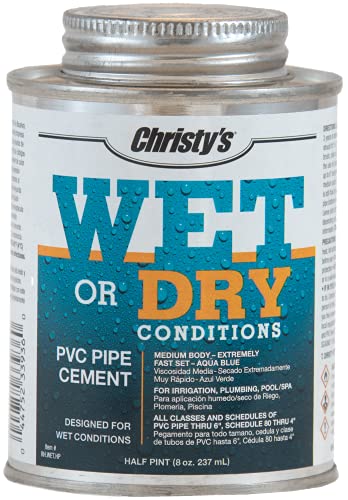
This product is best for small to medium PVC jobs in both wet and dry conditions without primers on compatible non-pressure systems. It is ideal for repairs or limited runs where speed and reliability are important. Potential limitation: verify system type to ensure primer not required for your specific application.
Christy’s Wet Or Dry Cement Medium Body

Best for non-pressurized systems up to 6″ and for pressurized lines below 4″ in wet or dry conditions. This cement is designed for a variety of PVC applications, including potable water and drainage systems. Caution: ensure compatibility with your pipe class and follow curing times for optimal strength.
Weld-On 12497 Wet ‘N Fast Cement

Best for projects in wet environments requiring a high-strength bond with extremely fast setting times. It is suitable for interference fits through 6″ and schedule 80 through 4″ diameters. Limitation: rapid set may require quick placement and fit to avoid misalignment.
Weld-On 12495 Wet ‘N Fast Quart

Choose this if you need a larger quantity for bigger runs in wet environments. It shares the same fast-setting, low-VOC formula and suitability for multiple PVC classes and schedules. Caution: ensure room ventilation due to solvent odors during application and curing.
Black Swan Wet-Or-Dry PVC Cement

Best for all classes and schedules up to 6″ with a quick, high-strength bond. It performs well in a range of temperatures (40°F to 100°F). Limitation: color is blue; if joints are exposed, color contrast may be noticeable on visible sections.
Christy’s Wet Or Dry Cement Medium Body 1 Pint

This medium-bodied cement supports quick sets in diverse moisture conditions and is suitable for various PVC systems, including conduit, drain, and sewer applications. Consider size when planning larger installations, as it may require multiple batches or larger volumes for extended runs.
Buying Guide
What to consider when selecting wet or dry PVC glue:
- Application type: Choose based on whether your system is pressurized, non-pressurized, potable water, or DWV. Some cements are optimized for wet environments, others for dry settings.
- Set time: Faster setting helps with tight schedules but can reduce maneuvering time. Pick a formula that matches your workflow.
- VOC and odor: Low-VOC formulas are preferred for better working conditions, especially in enclosed spaces.
- Class and size compatibility: Ensure the cement supports your pipe class, schedule, and diameter up to at least 6″ where applicable.
- Primer requirements: Some products work without primer on certain systems; verify primer needs for your installation.
- Tube or container size: For small repair jobs, 8 oz or 1 pint is convenient; larger projects may require quarts or multiple units.
- Temperature range: Check operating temperature range, especially if the environment fluctuates between cool and warm.
Frequently Asked Questions
- What is the difference between wet and dry PVC cement?
– Wet-set cements are formulated to cure quickly in moisture-rich environments, while dry-set options are optimized for typical room conditions. Both form a strong bond when used correctly. - Do these cements require primer?
– Some cements can function without primer on certain non-pressurized or potable water systems. Always verify system requirements before use. - Can I use these cements for pressure-rated piping?
– Yes, many are suitable for pressure systems below certain diameters; check the product specs for pressure suitability. - Is low-VOC important for indoor jobs?
– Yes. Low-VOC formulas reduce solvent exposure and odor, improving indoor air quality during bonding and curing. - What happens if I apply cement in very cold or very hot conditions?
– Temperature can affect set speed and bond strength. Follow product guidelines for the recommended operating range.